Writing a paving spec for a private lot
Last updated: By The Pavement Desk
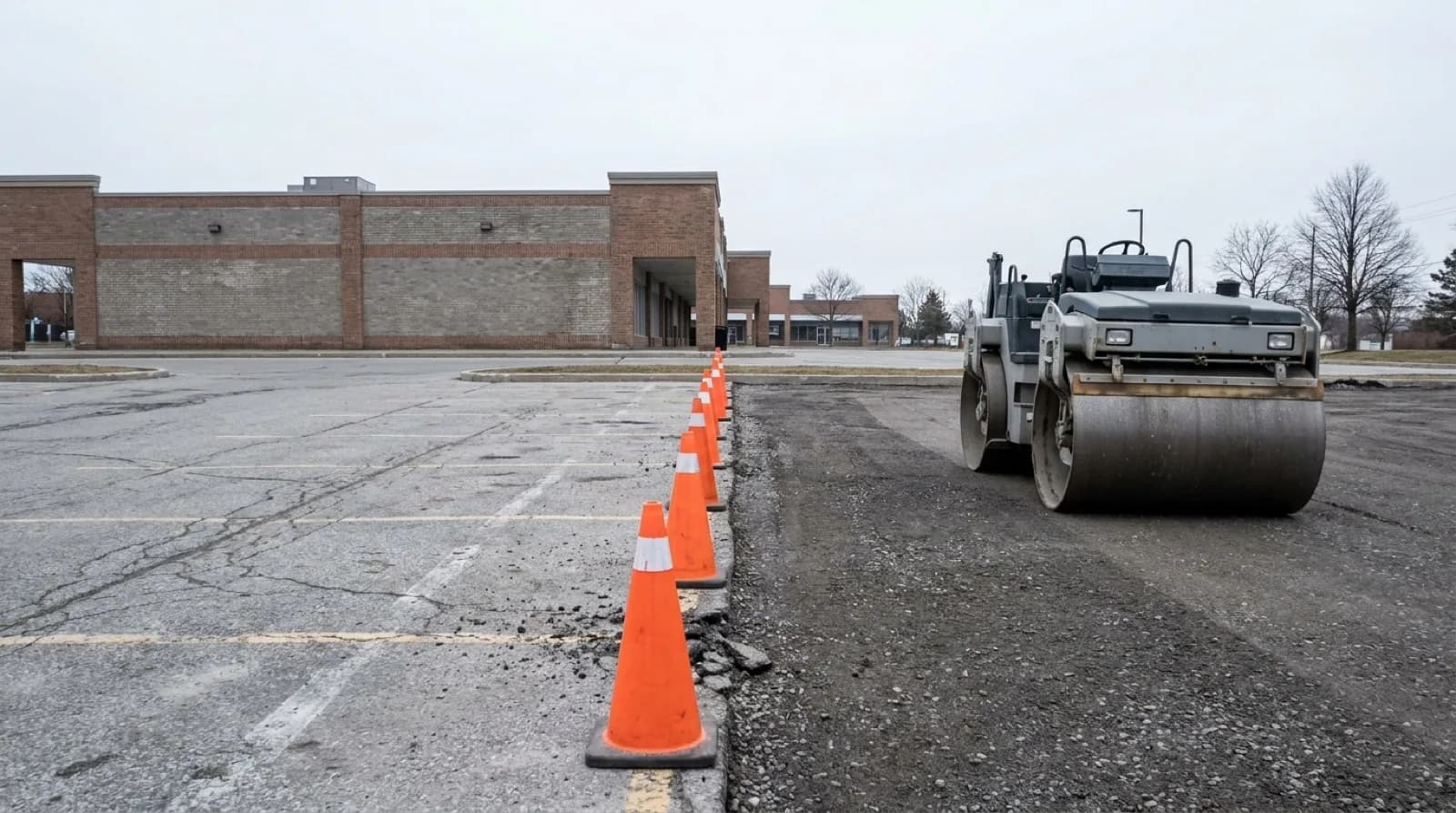
What a municipal estimate actually itemises
The Toronto estimate, prepared for a Municipal Class Environmental Assessment, prices full-depth removal of existing asphalt or concrete pavement at $40.80 per square metre, earthworks removal and disposal at $120.00 per cubic metre, Granular A base material at $34.00 per tonne, asphalt binder course HL-1 at $183.60 per tonne, asphalt surface course HL-8 at $142.80 per tonne, tack coat at $1.36 per square metre, and a new catch basin, fully installed, at $6,800 each. Seven lines, seven units, and each one describes a decision somebody made about the design.
The Region of Peel's 2022 functional cost estimate for the Arterial A2 and Coleraine Drive project in Brampton splits the same work differently and goes finer on drainage. It prices earth excavation at $27.50 per cubic metre, full-depth asphalt-only removal at $6.60 per square metre, a precast 600x600 catch basin structure to OPSD 705.010 at $900, a twin inlet basin to OPSD 705.020 at $1,900, frames and grates at $150 each, and lead pipe at $60.00 per linear metre for 150 mm PVC or $75.00 for 250 mm. Concrete curb and gutter runs $71.50 per linear metre in the Peel estimate against $122.40 in the Toronto one. Two real public documents, two different levels of granularity, and both are more specific than most private quotes.
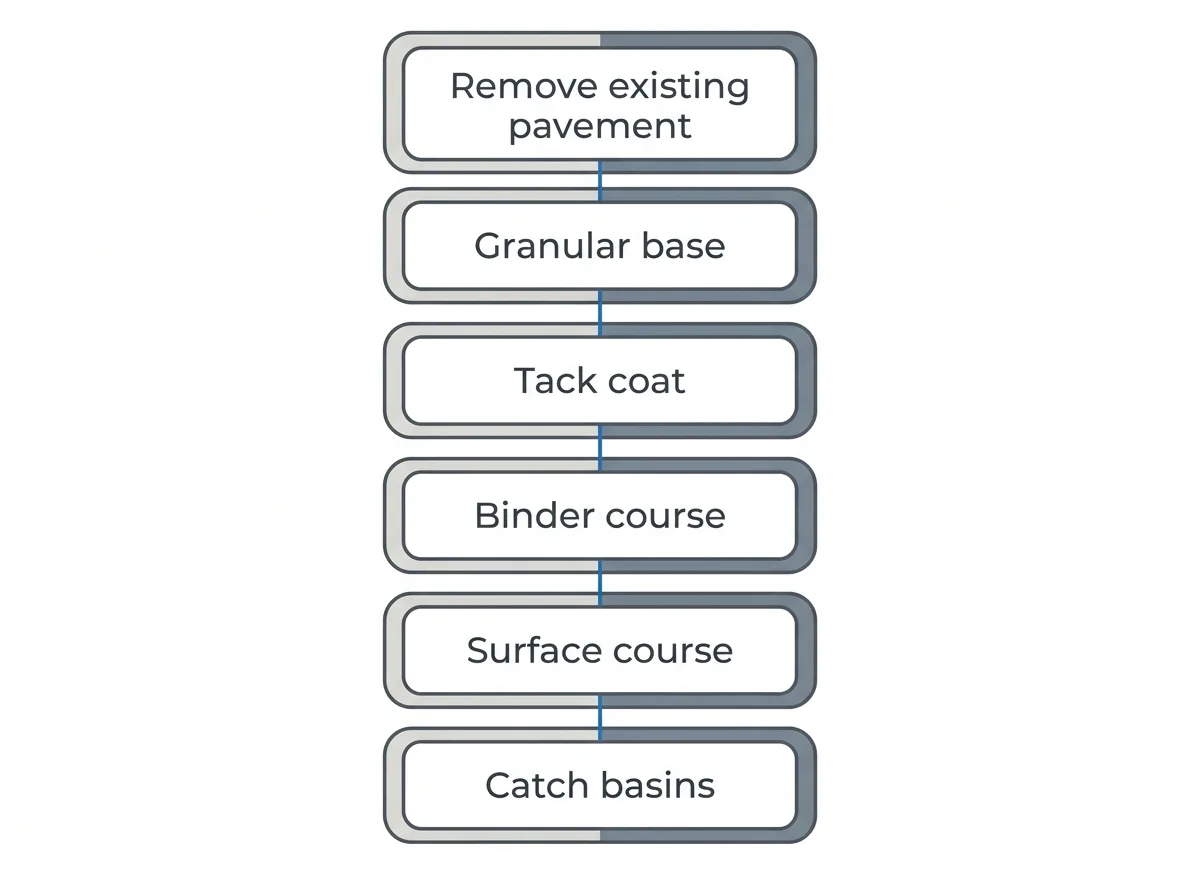
Every line is a question the bid has to answer
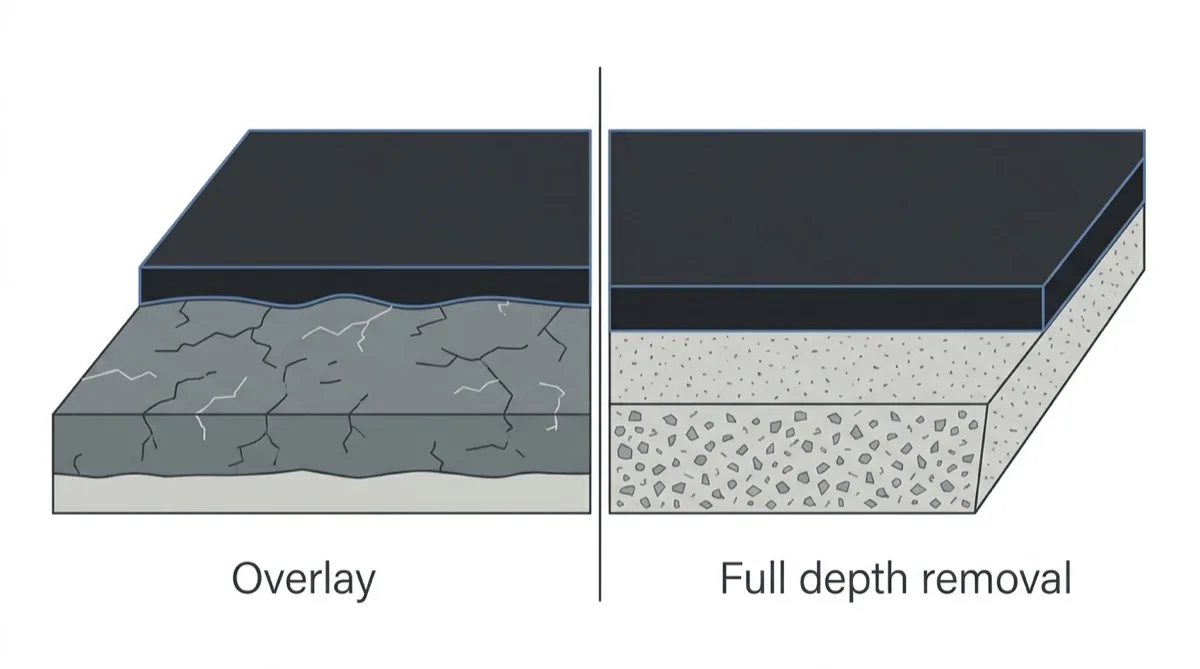
Set side by side, those two estimates make the scope questions obvious. Removal priced at $6.60 per square metre in Peel's estimate and $40.80 in Toronto's describes asphalt alone in the first case and asphalt plus concrete road base in the second, so a spec line reading pavement removal without naming the base has left the largest variable open. Excavation priced at $27.50 per cubic metre in Brampton against $120.00 per cubic metre downtown raises the same point about haul distance and disposal, and /costs/excavation-grading-cost-toronto/ treats that whole spread as the planning range rather than picking one.
Drainage splits the same way. A quote near the City of Toronto's $6,800 fully installed figure is buying a new basin with excavation and connection; a quote near the Region of Peel's $900 structure price plus $150 for frames and grates is buying a structure-and-frame swap, with the labour to break out and reset the old structure sitting in a separate line item that neither estimate itemizes. A spec that names the basin type, the OPSD standard, the lead pipe diameter and the run length converts a single drainage allowance into four checkable numbers, which is what /costs/catch-basin-repair-cost-toronto/ sets out to make possible.
The lines a private lot needs that a road spec does not
Stall markings are the clearest example. Zusashi Maintenance, serving Markham and the GTA since 2007, prices a water-based restripe of an existing lot at $4 to $9 per stall plus a mobilization fee of $150 to $350 per project. Toronto Line Painting quotes small plaza restripes of 20 to 30 stalls starting around $3 to $5 per stall. VIP Paving, a Toronto and GTA line painting contractor, prices straight runs on an open lot at $0.15 to $0.40 per linear foot, a new layout on a 10,000 square foot commercial lot at $450 to $1,200 as a project total, and the accessible parking symbol at $15 to $30 per stall on top of the stall paint. A spec that states restripe or new layout gets a different number than one that says line painting, since crews can follow existing markings in the first case and cannot in the second.
Curbs and coatings need the same treatment. Marcrete Contracting Ltd, serving Toronto and the GTA, prices minor curb repair at $20 to $50 per linear foot, moderate repair at $50 to $100, and full replacement or new installation at $100 to $250 or more per linear foot, tiers set by severity rather than length. On sealcoating, Zusashi Maintenance quotes $0.20 to $0.40 per square foot for a two-coat application, so a spec that omits the coat count invites a single-coat price that looks like a saving. Action Home Services, based in Toronto and Richmond Hill, quotes a minimum project charge of $300 for asphalt sealing on a lot of roughly 750 square feet, a floor worth naming in any scope small enough to hit it. Both topics are covered at /costs/concrete-curb-cost-toronto/ and /costs/line-marking-cost-toronto/.
Accessible stall counts, and the two rules that set them
This is the line most private specs get wrong, because two instruments answer the same question with different numbers. Ontario Regulation 191/11, the Integrated Accessibility Standards made under the AODA, requires at section 80.36 (1) one space meeting the Type A requirements where there are 12 parking spaces or fewer, four per cent of the total where there are 13 to 100, one space plus an additional three per cent between 101 and 200, two spaces plus an additional two per cent between 201 and 1,000, and eleven spaces plus an additional one per cent above 1,000, rounding up. Section 80.34 sets a minimum width of 3,400 mm for a Type A space and 2,400 mm for a Type B, and section 80.35 (2) requires a shared access aisle of at least 1,500 mm running the full length of the space, marked with high tonal contrast diagonal lines.
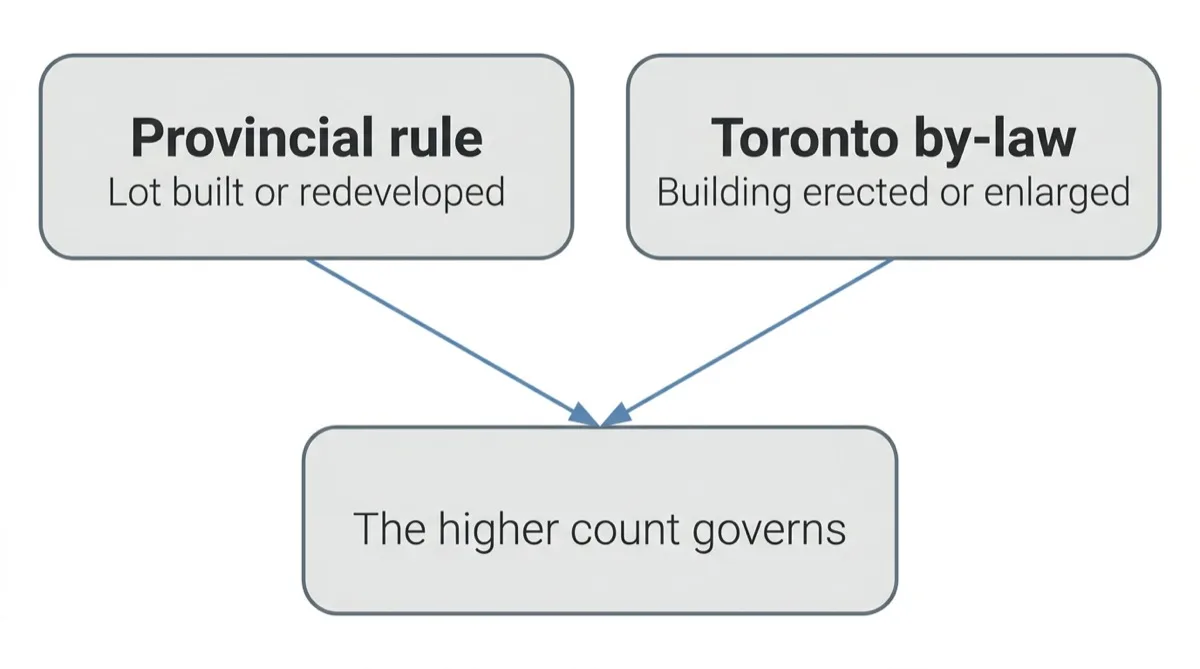
Inside Toronto the city sets its own rate. Zoning By-law 569-2013, regulation 200.15.10.10 (1), requires one accessible space where there are fewer than 13 effective parking spaces, one for every 25 effective spaces or part thereof from 13 to 100, and five spaces plus one for every 50 effective spaces or part thereof above 100, on the same lot as every building or structure erected or enlarged. Medical offices and clinics are rated separately at 10 per cent, rounded up, under 200.15.10.10 (2). Scope decides which one bites: the provincial rule attaches to constructing or redeveloping a parking facility, and section 80.1 excludes maintenance, whose own definition gives painting and minor repairs as examples, while the zoning rate attaches to a building being erected or enlarged. A project can be caught by one, both or neither, and where both apply the higher count governs. The city's July 31, 2024 office consolidation also prints two versions of the minimum stall width in 200.15.1 (1), 3.9 metres and a 3.4 metre version marked as under appeal, which is a detail to confirm with City Planning before stalls are laid out.
The permit and licence lines
A schedule is part of a spec. Work touching City of Toronto property, such as a boulevard, sidewalk or curb cut connecting a lot to the street, requires a street work permit from the City's District Right-of-Way Management office, and that permit is issued only to a driveway paving contractor licensed by Municipal Licensing and Standards. Requests for new driveway and walkway work must be submitted at least eight weeks before work starts, which is a long enough lead time to move a summer job into the fall if it is missed.
The licence itself is a cost the contractor carries and the price reflects. The City of Toronto charges $495.12 for the application and licence together, $293.14 to renew each year, and requires $2,000,000 in commercial general liability insurance plus a criminal record and judicial matters check. Excavation within the public right-of-way carries a further City of Toronto construction permit at $227.26 plus restoration costs, and on private land a municipal site alteration permit can apply, since Ontario municipalities regulate filling, grading and excavation under section 142(1) of the Municipal Act, 2001. One more line belongs on the front page of any spec: Ontario's HST rate is 13%, confirmed on the province's own HST page, which on a $50,000 project is a $6,500 difference between a quote written HST-included and one written HST-extra.
What the index cannot put into a spec
The company data behind this site stops well short of a bid document. It records name, area, category, rating, review count and contact fields, and holds no licence status, no warranty terms, no completion timelines, no crew sizes and no email addresses on any of the 376 records. Nothing in it verifies that a company can perform the scope described above, which is why the site publishes categories and counts rather than recommendations.
The price data has limits worth stating inside the spec as well. Most topics on this site rest on one or two named contractors publishing their own rates, alongside municipal cost estimates from public projects rather than private tenders. Cost-aggregator pages that publish wider ranges without naming an author or a method are excluded, so the figures a spec quotes as a benchmark should be quoted with their source attached, the same way the municipal estimates attach a unit to every line. A benchmark a buyer cannot point to is not much use in a conversation about a bid.
Frequently asked questions
Why itemise a private paving scope at all?
- Because a single bundled number hides the variables that move it. The City of Toronto's preliminary cost estimate for the Broadview Avenue Extension prices removal, tack coat, base material, surface course and catch basins as separate lines, and a private scope written the same way lets two bids be compared line by line instead of total against total.
What is the biggest variable in a removal line?
- Whether the base comes out with the asphalt. The Region of Peel's 2022 Brampton estimate prices asphalt-only removal at $6.60 per square metre, while the City of Toronto's Broadview Avenue Extension estimate prices removal of asphalt and concrete road base together at $40.80 per square metre. Both describe full-depth removal in plain language.
How many accessible stalls does a commercial lot need in Toronto?
- Two instruments answer differently. Ontario Regulation 191/11, section 80.36 (1), requires four per cent of the total for lots of 13 to 100 spaces, but only for a newly constructed or redeveloped facility. Toronto Zoning By-law 569-2013, regulation 200.15.10.10, requires one space for every 25 effective spaces in that band when a building is erected or enlarged.
Does a restripe trigger the provincial accessible parking rule?
- Not on its own. Section 80.32 applies the provincial requirements to an obligated organisation constructing new or redeveloping an off-street parking facility, and section 80.1 defines redeveloped as planned significant alterations while expressly excluding maintenance, whose definition gives painting and minor repairs as examples. A significant reconfiguration is a different matter.
What permits belong in the spec's schedule?
- Work touching City property needs a street work permit from Toronto's District Right-of-Way Management office, requested at least eight weeks before the work starts and issued only to a licensed driveway paving contractor. Excavation in the public right-of-way carries a separate $227.26 City of Toronto construction permit plus restoration costs.