Skip to content
AsphaltPavingIndex

Parking Lot Line Marking rates in Toronto and the GTA, 2026: what a bid should show

A water-based restripe of an existing lot runs $4 to $9 per stall in the GTA according to Zusashi Maintenance, plus a $150 to $350 mobilization fee that applies whatever the stall count. Toronto Line Painting prices a 20 to 30 stall plaza at $3 to $5 per stall. A new layout on a 10,000 square foot lot runs $450 to $1,200 per VIP Paving.

Last updated: By The Pavement Desk

$4–$9

per stall (CAD), water-based restripe, existing lot with visible lines

3

named sources behind the table below

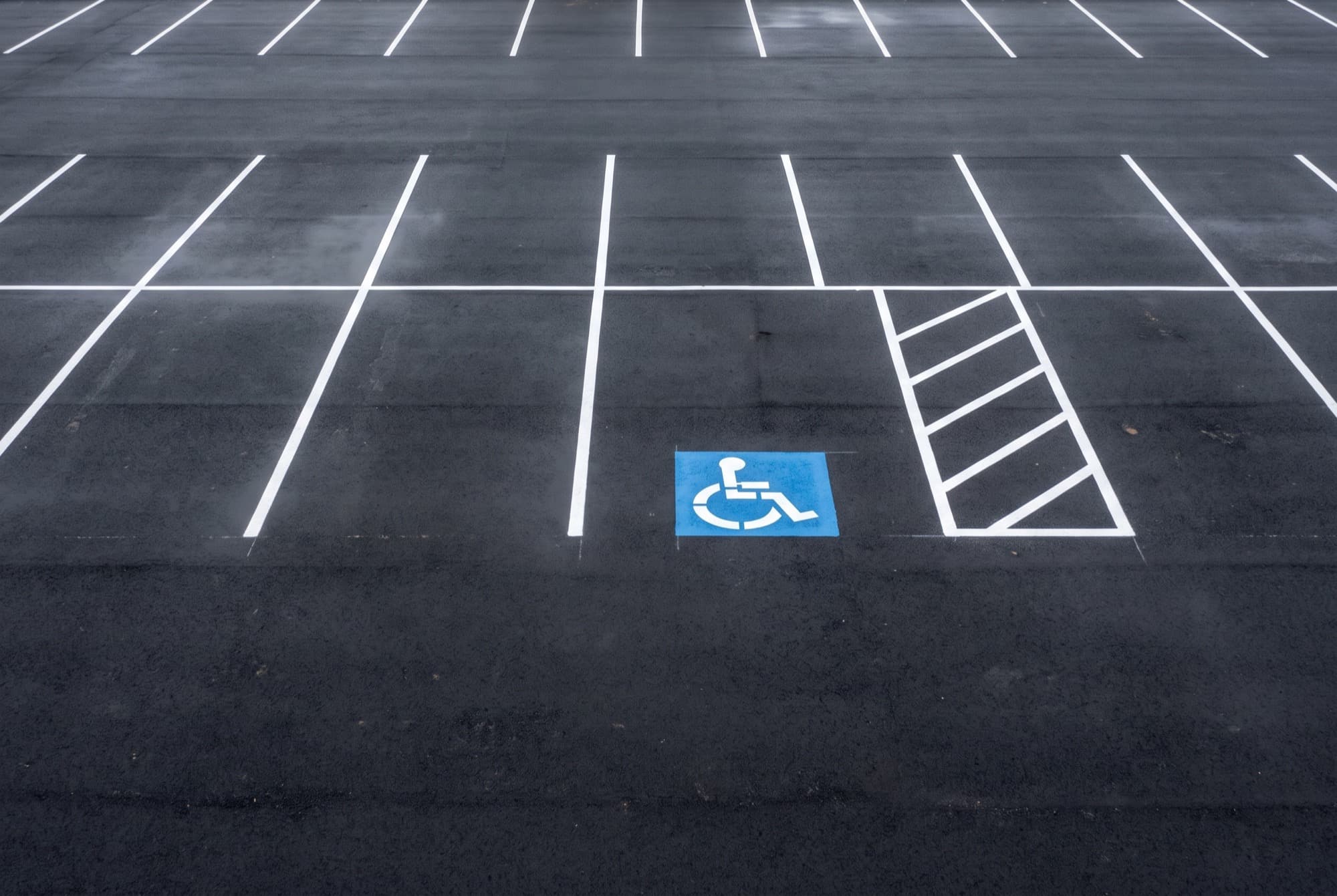
A section of an empty asphalt parking lot seen almost from above, filled with fresh crisp white stall lines on black asphalt, one blue and white painted accessible parking symbol, and a hatched access aisle of white diagonal stripes beside it.
A generated illustration of a marked bay, not a photograph of a specific property. The hatched aisle and the symbol beside it are the two elements the accessible stall rules quoted further down this page govern, and the picture carries no figure of its own.

What does line marking cost per stall and per layout?

The 6 rows below come from 3 named Canadian sources; where they disagreed, the range was widened rather than one picked. A row that shows a single figure is one published price rather than a researched band. A further 4 sources are cited elsewhere on this page. Read the table as a benchmark for checking a bid, not as a price for your site: scope, access, phasing and what is found under the surface all move the number.

Six rows across five units, drawn to scale within each unit. Two per-stall figures on the same axis is the whole reading: a small plaza restripe starts around $3 to $5 per stall and a standard water-based restripe runs $4 to $9, and both sit under a mobilization charge that is priced per project rather than per stall.

per stall (CAD)
  • Water-based restripe, existing lot with visible lines

    $4–$9

    Zusashi Maintenance (Markham and the GTA, since 2007)

  • Small plaza restripe, 20 to 30 stalls

    $3–$5

    Toronto Line Painting

$0$9
per project, add-on (CAD)
  • Mobilization fee for a line striping or restriping job

    $150–$350

    Zusashi Maintenance (Markham and the GTA, since 2007)

$0$350
per linear foot (CAD)
  • Line painting priced by footage, straight runs on an open lot

    $0.15–$0.40

    VIP Paving (Toronto and GTA)

$0$0.40
per project (CAD)
  • New line layout on a 10,000 square foot commercial lot

    $450–$1,200

    VIP Paving (Toronto and GTA)

$0$1,200
per symbol (CAD)
  • Accessible parking symbol marking, per stall

    $15–$30

    VIP Paving (Toronto and GTA)

$0$30
  • Water-based restripe, existing lot with visible lines

    Price
    $4–$9
    Unit
    per stall (CAD)
    Applies to
    Water-based restripe of an existing lot, priced per stall, which the source says already includes the two side lines and the end line. The source states that a mobilization fee and a $250 minimum job charge apply on top.
  • Mobilization fee for a line striping or restriping job

    Price
    $150–$350
    Unit
    per project, add-on (CAD)
    Applies to
    Charged per project on top of per-stall pricing. The source also states that a $250 minimum job charge applies.
  • Small plaza restripe, 20 to 30 stalls

    Price
    $3–$5
    Unit
    per stall (CAD)
    Applies to
    The source prices this as starting at around $3 to $5 per stall for basic restriping, so it is a floor and not a range, and states that a minimum job fee or mobilization cost applies to every project.
  • Line painting priced by footage, straight runs on an open lot

    Price
    $0.15–$0.40
    Unit
    per linear foot (CAD)
    Applies to
    The source writes this range as $0.15 to $0.40+, so $0.40 is not a ceiling. It says the rate depends on the condition of the asphalt and the complexity of the layout, and that fresh layouts or lots that require layout marking may fall on the higher end.
  • New line layout on a 10,000 square foot commercial lot

    Price
    $450–$1,200
    Unit
    per project (CAD)
    Applies to
    The source gives this as an average in a lot-size table and says the cost also depends on the condition of the asphalt, whether the lot requires a sealant, and whether accessible spaces are needed. It separately states that a new parking lot costs approximately 50% to 70% more than an older parking lot that was previously painted.
  • Accessible parking symbol marking, per stall

    Price
    $15–$30
    Unit
    per symbol (CAD)
    Applies to
    The source lists this among its parking lot striping cost factors as the typical cost of the symbol itself and attaches no further condition to the figure.

What is priced across one bay of stalls?

A striping quote is a per-stall rate, a per-symbol rate, a per-foot rate and a flat fee added together, and which of them apply depends on whether the crew is following lines already on the ground. Painting a brand new layout costs more than repainting existing, visible lines because crews cannot follow old markings.

Restripe of an existing, visible layoutThe crew follows what is already painted.
Standard stalls
Access aisle
Accessible stall and symbol

$4 to $9 per stall (CAD), which already includes the two side lines and the end line

Standard stalls
Standard stalls. Repainting over an existing, still-visible layout. Cheaper than a new layout because the crew follows lines already on the ground instead of measuring and chalking the lot from a drawing.
Access aisle
Access aisle. Section 80.35 (2) of Ontario Regulation 191/11 sets a shared access aisle of at least 1,500 mm that runs the full length of the space and is marked with high tonal contrast diagonal lines on asphalt or concrete.
Accessible stall and symbol
Accessible stall and symbol. Each accessible stall costs more than a standard one because of the wheelchair symbol and layout, with symbols alone priced at $15 to $30.
A new layout, set out from a drawingNothing on the ground to follow, so the lot is measured and chalked first.
Layout set out
Stalls painted to the set-out
Accessible spaces, counted by rule

$450 to $1,200 per project (CAD), new layout on a 10,000 square foot commercial lot

Layout set out
Layout set out. A new parking lot costs approximately 50% to 70% more than an older parking lot that was previously painted, and fresh layouts or lots that require layout marking fall on the higher end of the $0.15 to $0.40 per linear foot band.
Stalls painted to the set-out
Stalls painted to the set-out. A standard water-based restripe runs $4 to $9 per stall while thermoplastic paint, which lasts three to seven years versus one to two for water-based, costs more upfront.
Accessible spaces, counted by rule
Accessible spaces, counted by rule. O. Reg. 191/11 s. 80.36 (1) requires one Type A space at 12 spaces or fewer and four per cent of the total from 13 to 100 spaces, while inside Toronto, Zoning By-law 569-2013 reg. 200.15.10.10 instead requires one accessible space for every 25 effective spaces in that same 13 to 100 band. Where both apply, meet the higher count.

Not to scale, and stall widths in the drawing are proportions rather than dimensions. A flat $150 to $350 mobilization fee applies on top of per-stall pricing for the crew to arrive on site, and it sits outside both drawings because it is charged per project rather than per stall.

What drives the price?

Scope, site access, phasing and what is found under the surface move line marking pricing further than any other factor in the GTA. Two bids on one lot are rarely the same job, so read the list below as the things to check a bidder has priced rather than quietly excluded.

  • Paint type: a standard water-based restripe runs $4 to $9 per stall while thermoplastic paint, which lasts three to seven years versus one to two for water-based, costs more upfront (Zusashi Maintenance)
  • Job size and mobilization: a small plaza of 20 to 30 stalls can start around $3 to $5 per stall (Toronto Line Painting), while a full new layout on a 10,000 square foot lot runs $450 to $1,200 as a project total (VIP Paving)
  • New layout versus restripe: painting a brand new layout costs more than repainting existing, visible lines because crews cannot follow old markings (VIP Paving)
  • Accessible stall requirements: each accessible stall costs more than a standard one because of the wheelchair symbol and layout, with symbols alone priced at $15 to $30 (Zusashi Maintenance; VIP Paving)
  • Mobilization: a flat $150 to $350 fee applies on top of per-stall pricing for the crew to arrive on site (Zusashi Maintenance)
  • Number of accessible stalls required by the site's total stall count, and which rule the project falls under: O. Reg. 191/11 s. 80.36 (1) requires one Type A space at 12 spaces or fewer and four per cent of the total from 13 to 100 spaces, but only where the facility is being newly constructed or redeveloped, while inside Toronto Zoning By-law 569-2013 reg. 200.15.10.10 instead requires one accessible space for every 25 effective spaces in that same 13 to 100 band when a building is erected or enlarged

What's specific to Ontario and Toronto?

Ontario rules and municipal bylaws change the math in ways a national price guide misses, and several of them decide whether a bid is even complete. Here is what applies locally, from HST to permits to licensing.

  • Ontario's HST rate is 13%, confirmed on the province's own HST page. Ask whether a line painting quote is HST-included or HST-extra.
  • How many accessible parking spaces a commercial lot needs in Ontario is answered by two different instruments, and they do not give the same count. Provincially, Ontario Regulation 191/11 (Integrated Accessibility Standards) made under the AODA, section 80.36 (1), requires one space meeting the Type A requirements where there are 12 parking spaces or fewer; four per cent of the total where there are between 13 and 100; one space plus an additional three per cent between 101 and 200; two spaces plus an additional two per cent between 201 and 1,000; and eleven spaces plus an additional one per cent above 1,000, rounding up to the nearest whole number. Section 80.34 sets a minimum width of 3,400 mm for a Type A (van accessible) space and 2,400 mm for a Type B space, and section 80.35 (2) sets a shared access aisle of at least 1,500 mm that runs the full length of the space and is marked with high tonal contrast diagonal lines on asphalt or concrete.
  • Scope is the part contractors leave out. Section 80.32 applies the provincial requirements only when an obligated organization is constructing new or redeveloping an off-street parking facility it intends to maintain, and section 80.1 defines redeveloped as planned significant alterations while expressly excluding maintenance, whose own definition gives painting and minor repairs as examples. A like-for-like restripe of an existing lot therefore does not by itself trigger the provincial minimum; a new lot or a significant reconfiguration does. Section 80.5 phased the standard in by organisation size, ending with small organisations (at least one but fewer than 50 employees in Ontario) on January 1, 2018, so every obligated organisation is now inside the schedule.
  • Inside Toronto the city sets its own rate, and it is not the provincial four per cent. Zoning By-law 569-2013, regulation 200.15.10.10 (1), requires, on the same lot as every building or structure erected or enlarged, a minimum of one accessible space where there are fewer than 13 effective parking spaces, one for every 25 effective spaces or part thereof where there are 13 to 100, and five spaces plus one for every 50 effective spaces or part thereof above 100. Medical offices and clinics are rated separately at 10 per cent, rounded up, under regulation 200.15.10.10 (2). The by-law also sets its own stall dimensions in 200.15.1 (1); the city's July 31, 2024 office consolidation prints two versions of the minimum width, 3.9 metres and a 3.4 metre version marked as under appeal, so confirm the operative figure with City Planning before laying out stalls. Because the zoning rate attaches to a building being erected or enlarged and the provincial rule attaches to construction or redevelopment of the parking facility, a project can be caught by one, both, or neither. Where both apply, meet the higher count.

How can I pay less?

You can bring line marking costs down without cutting the parts that decide how long the work lasts. These are the levers that hold up on a commercial site, each tied to a real number in the table above.

  • Combine striping with another maintenance visit already booked on site to avoid the separate $150 to $350 mobilization fee (Zusashi Maintenance).
  • Choose water-based paint at $4 to $9 per stall for a routine restripe rather than thermoplastic, and reserve the more durable, pricier option for high-traffic drive lanes (Zusashi Maintenance).
  • Get a small plaza (20 to 30 stalls) priced against the $3 to $5 per stall Toronto Line Painting benchmark before accepting a higher quote.
  • Ask whether your lot is better priced per stall or per linear foot. VIP Paving's linear-foot pricing at $0.15 to $0.40 per linear foot can work out cheaper than per-stall pricing on a large open lot with long straight runs.
  • Count your required accessible stalls before requesting a quote, and work out which rule the job is actually under. Symbols run $15 to $30 each on top of the stall paint (VIP Paving). A straight restripe of an existing lot is maintenance and does not by itself trigger the provincial minimum in O. Reg. 191/11 s. 80.32, while a new lot or a significant reconfiguration does, and inside Toronto a building being erected or enlarged pulls in the separate zoning rate.

How did we research these numbers?

Every figure on this page comes from a named Canadian source, and where sources disagreed the range was widened rather than one picked. Where public commercial pricing for a scope is genuinely thin, that is said plainly rather than papered over with an estimate. Here is how the numbers were reconciled.

  • Restriping an existing commercial lot in the GTA runs $4 to $9 per stall according to Zusashi Maintenance, a Markham-based contractor serving the GTA since 2007, plus a $150 to $350 mobilization fee that applies regardless of stall count. Toronto Line Painting independently quotes small plaza restripes of 20 to 30 stalls starting around $3 to $5 per stall.
  • VIP Paving, a Toronto and GTA line painting contractor, prices work by linear footage on large open lots at $0.15 to $0.40 per linear foot, and separately publishes a lot-size table showing a new line layout on a 10,000 square foot lot running $450 to $1,200 as a total project cost.
  • Accessible parking symbols cost more than a standard stall line. VIP Paving prices the wheelchair symbol itself at $15 to $30 per stall, on top of the stall paint. Zusashi Maintenance separately notes that each accessible stall costs more than a standard one because of the symbol and layout, without publishing an exact figure.
  • Paint type changes the long-term cost even when the per-stall quote looks similar. Zusashi Maintenance describes water-based paint as the standard option, lasting one to two years, and thermoplastic as a heat-applied alternative that lasts roughly three to seven years and costs more upfront, though the page does not publish a dollar figure for thermoplastic specifically.
  • A new layout costs more than repainting existing, visible lines because crews cannot follow old markings and must lay out the plan from scratch (VIP Paving). Confirm which scope you are being quoted for before comparing bids.

Sources

Who bids this work in the GTA?

AsphaltPavingIndex tracks 51 line marking contractors across the Greater Toronto Area, rated 4.73★ on average. The three below sit highest on the published score across those 51 firms, August 2026. Call any of them, or open a profile and add it to the bid list.

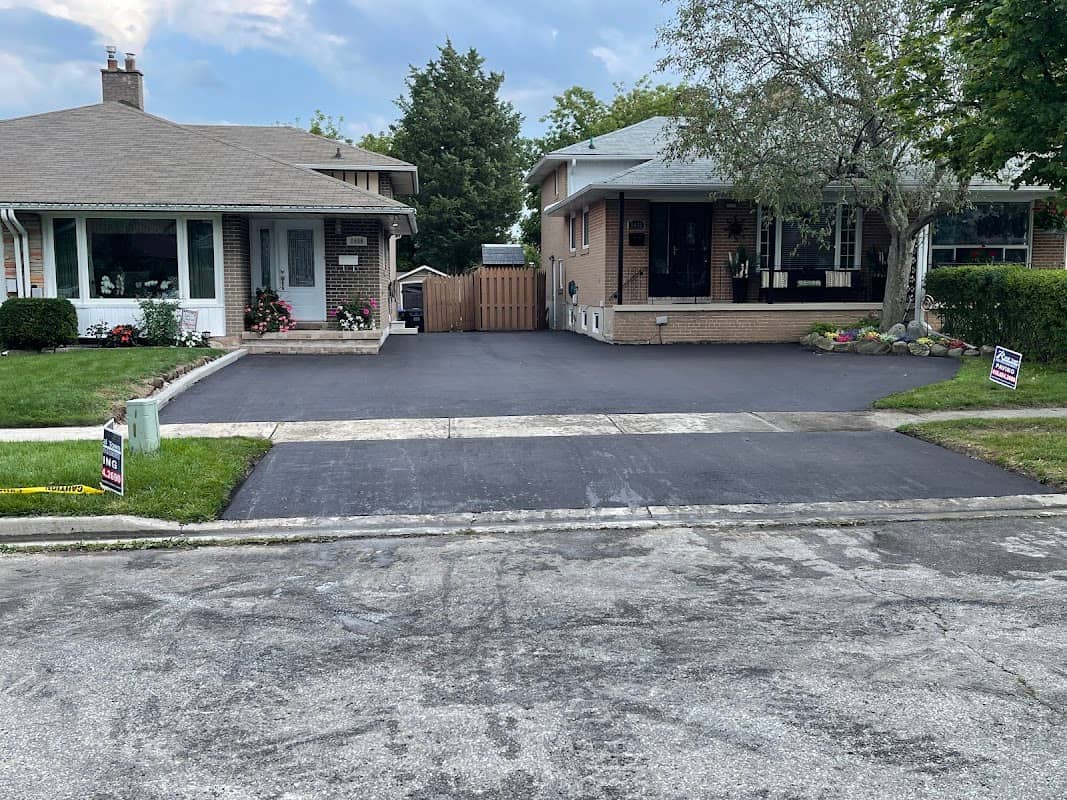
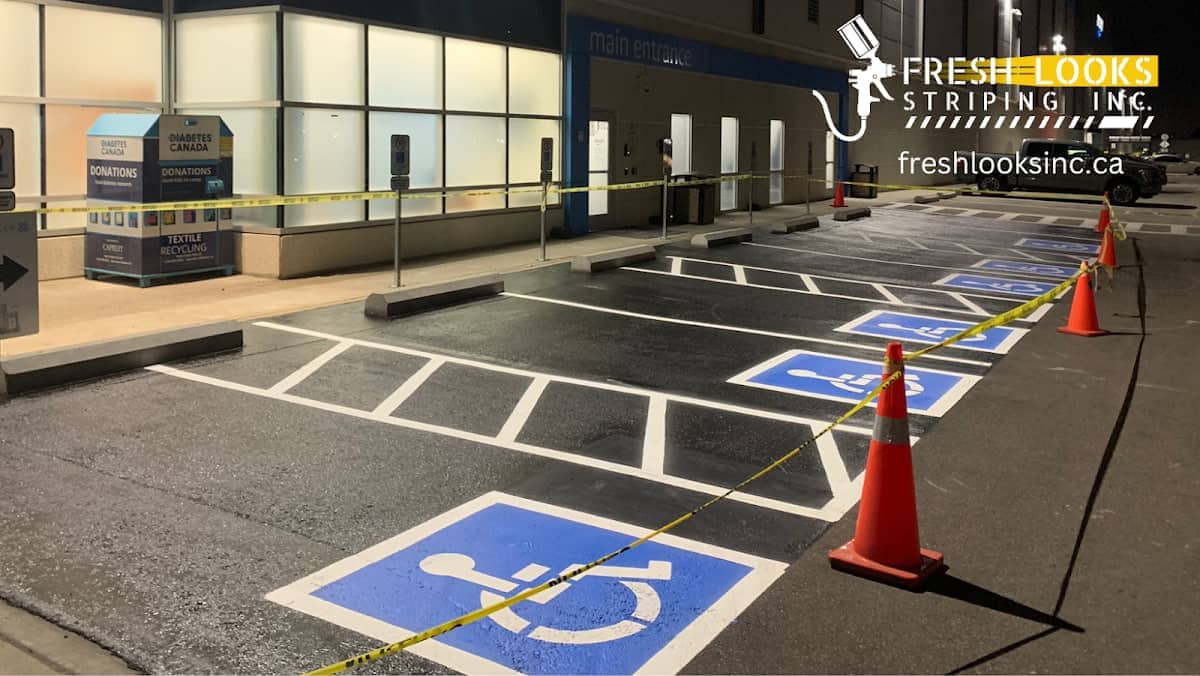
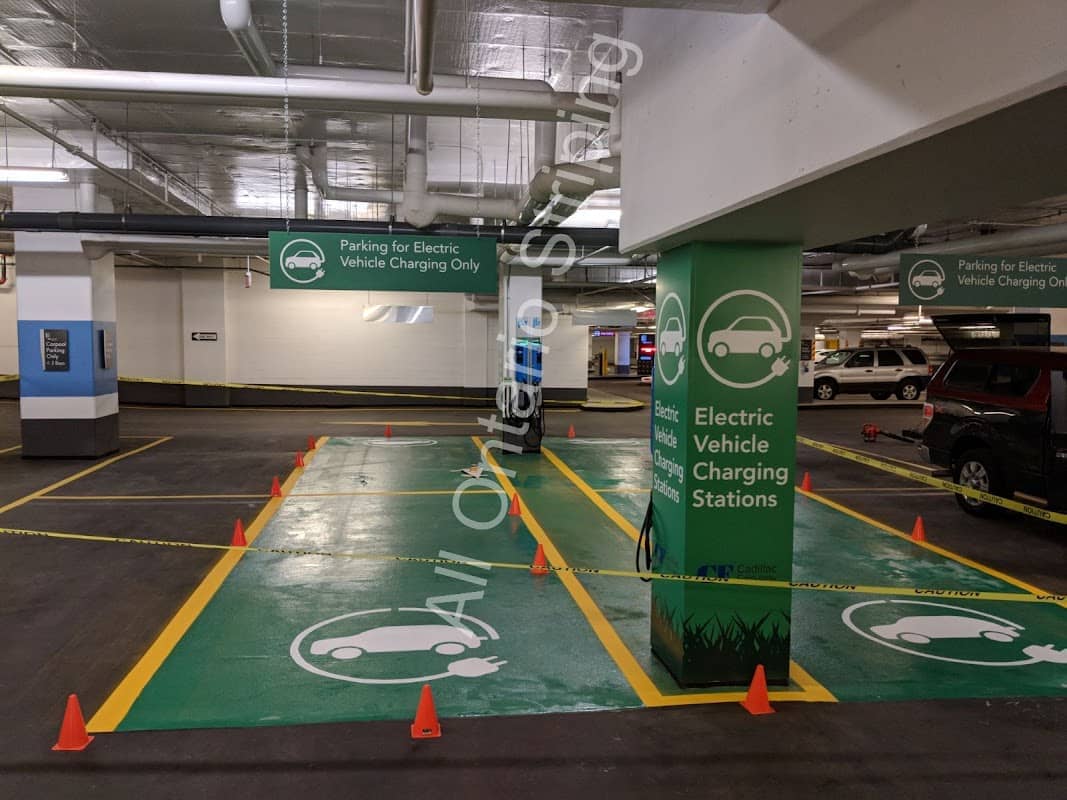
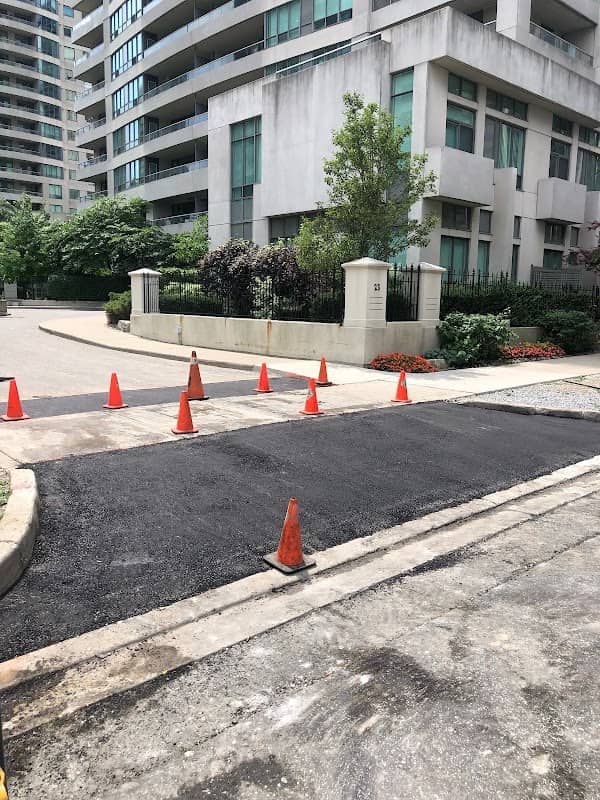
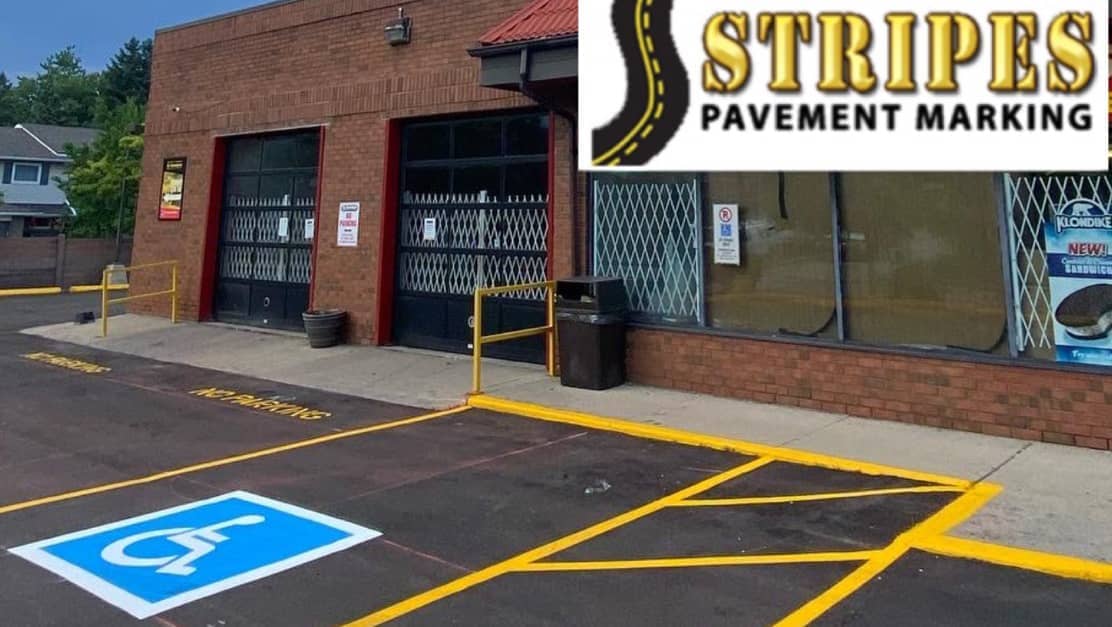
Photographs the highest-ranked line marking firms on this site published on their own profiles. Paint is the one trade on this site whose result is entirely visible in a photograph, so these are worth more here than on any other guide: line width, spacing and whether the symbol was stencilled or freehanded are all in the frame.
See all 51 ranked line marking contractors

What do the terms in a bid mean?

Three words decide most of what a line marking bid is actually offering, and a quote uses them without explaining them. Here is what each one means on the line items priced above.

Restripe
Repainting over an existing, still-visible layout. Cheaper than a new layout because the crew follows lines already on the ground instead of measuring and chalking the lot from a drawing.
Minimum job fee
A floor charge that applies however few stalls are painted, covering the trip and the setup. On a twenty-stall plaza it can be a larger share of the invoice than the paint.
Thermoplastic
Marking material melted onto the surface rather than rolled or sprayed. Costs considerably more than water-based paint per stall and lasts several times as long under traffic and plough blades.

Where should I look next?

Most lots need more than one of these at a time, and the cheapest mistake to avoid is pricing this work without seeing what it sits next to. These are the guides, comparisons and calculators on this site that carry on from here.

Frequently asked questions

How much does line painting cost per stall in Toronto?

A standard water-based restripe of an existing lot runs $4 to $9 per stall according to Zusashi Maintenance. Toronto Line Painting independently quotes small plaza restripes of 20 to 30 stalls starting around $3 to $5 per stall.

Is there a mobilization or minimum fee for line painting?

Yes. Zusashi Maintenance charges a $150 to $350 mobilization fee on top of per-stall pricing, so a small job pays this flat charge regardless of stall count.

How much do accessible or handicap parking symbols cost?

VIP Paving prices the wheelchair symbol marking itself at $15 to $30 per stall, on top of the regular stall lines. Zusashi Maintenance notes that each accessible stall costs more overall because of the symbol and layout requirements.

How many accessible parking spaces does my commercial lot need in Ontario?

Two instruments answer this and they give different numbers. Provincially, O. Reg. 191/11 s. 80.36 (1) requires one Type A space where a lot has 12 spaces or fewer, four per cent of the total between 13 and 100 spaces, one space plus three per cent between 101 and 200, two spaces plus two per cent between 201 and 1,000, and eleven spaces plus one per cent above 1,000, rounding up. Type A spaces are at least 3,400 mm wide, Type B at least 2,400 mm, with a shared access aisle of at least 1,500 mm (ss. 80.34 and 80.35). That rule applies only where an obligated organization constructs a new off-street parking facility or redevelops one; redeveloped means planned significant alterations and excludes maintenance such as repainting (s. 80.32 and s. 80.1). Inside Toronto, Zoning By-law 569-2013 reg. 200.15.10.10 (1) instead requires one accessible space below 13 effective spaces, one per 25 effective spaces or part thereof from 13 to 100, and five plus one per 50 above 100, tied to a building being erected or enlarged. Where both apply, meet the higher count, and confirm the layout with City Planning before you stripe. Budget the $15 to $30 per-symbol cost for however many stalls that works out to, plus the permit sign that s. 80.37 requires under R.R.O. 1990, Reg. 581 s. 11.

Does Ontario's HST apply to line painting?

Yes. Ontario's HST rate is 13%. On a lot priced within the $4 to $9 per stall range, or the $450 to $1,200 range for a full new layout, confirm whether the quote you received is HST-in or HST-out before comparing bids.

What does a full new line layout cost compared to a restripe?

A new layout on a 10,000 square foot lot runs $450 to $1,200 as a total project cost (VIP Paving), while restriping existing, visible lines on the same lot is priced per stall at $4 to $9 (Zusashi Maintenance), since a new layout requires laying out the plan from scratch rather than following old markings.

Questions to ask your contractor

  • What is the price per stall, and what is the minimum call-out? Compare the two approaches
  • Are accessible spaces, access aisles and permit symbols marked to the AODA standard?
  • Are fire route markings and signage included to the municipal standard?
  • Paint or thermoplastic, and how long until the lot takes traffic?
  • Is layout being changed, or restored exactly as found? Who signs off the plan?