A Three-Year Maintenance Plan for a GTA Lot
Last updated: By The Pavement Desk
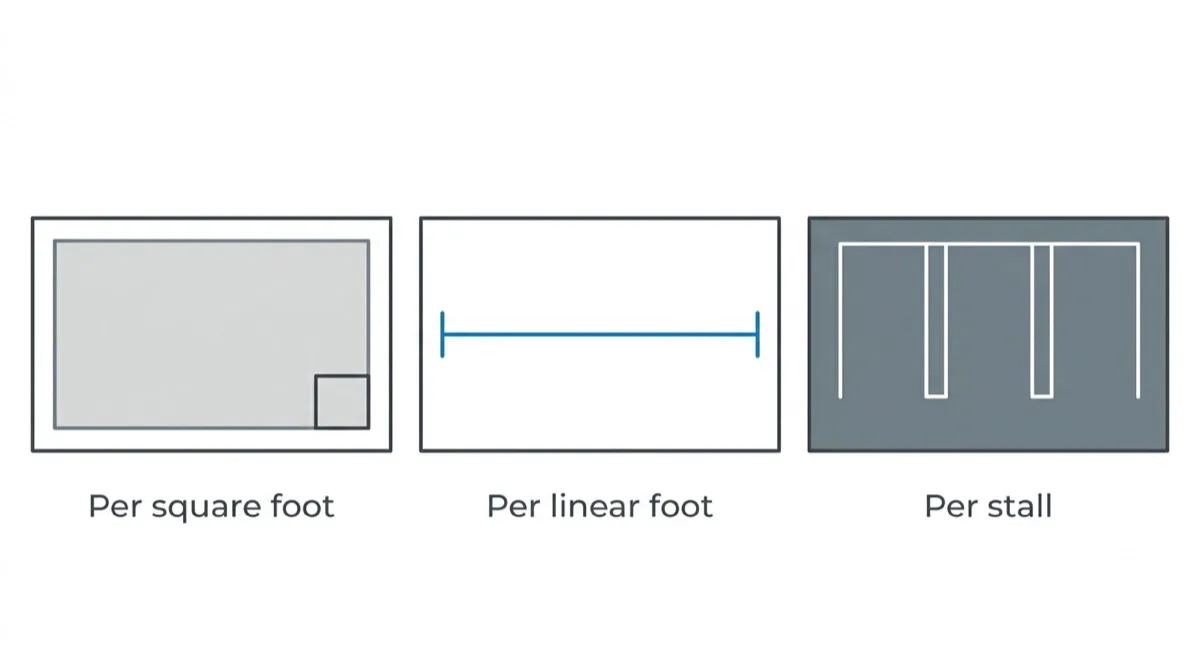
The three items and what each is measured by
Sealcoating is priced across the whole surface. Zusashi Maintenance quotes $0.20 to $0.40 per square foot for commercial parking lot sealcoating in Mississauga and the GTA, on a two-coat application it describes on its own page. That coat count matters for comparison, since the same guide notes that a single-coat quote priced against a two-coat rate reads as a bargain without being one.
Crack sealing is priced along the crack. The same Zusashi Maintenance page quotes $1 to $3 per linear foot for hot rubberized crack sealing, applied ahead of a sealcoat, and prices it separately from the per-square-foot coating rate. Striping is priced by the stall. Zusashi Maintenance quotes $4 to $9 per stall for a water-based restripe of an existing lot, plus a mobilization fee of $150 to $350 that applies regardless of stall count. Toronto Line Painting independently quotes small plaza restripes of 20 to 30 stalls starting around $3 to $5 per stall.
Those three units do not convert into each other. A lot's square footage says nothing about how many linear feet of cracking it carries or how many stalls fit on it, which means a three-year budget needs three separate measurements rather than one. Zusashi Maintenance's own worked example puts a 10,000 square foot commercial lot at $2,000 to $4,000 for the sealcoat, and that figure covers the coating line only.
Year one: the full pass, in order
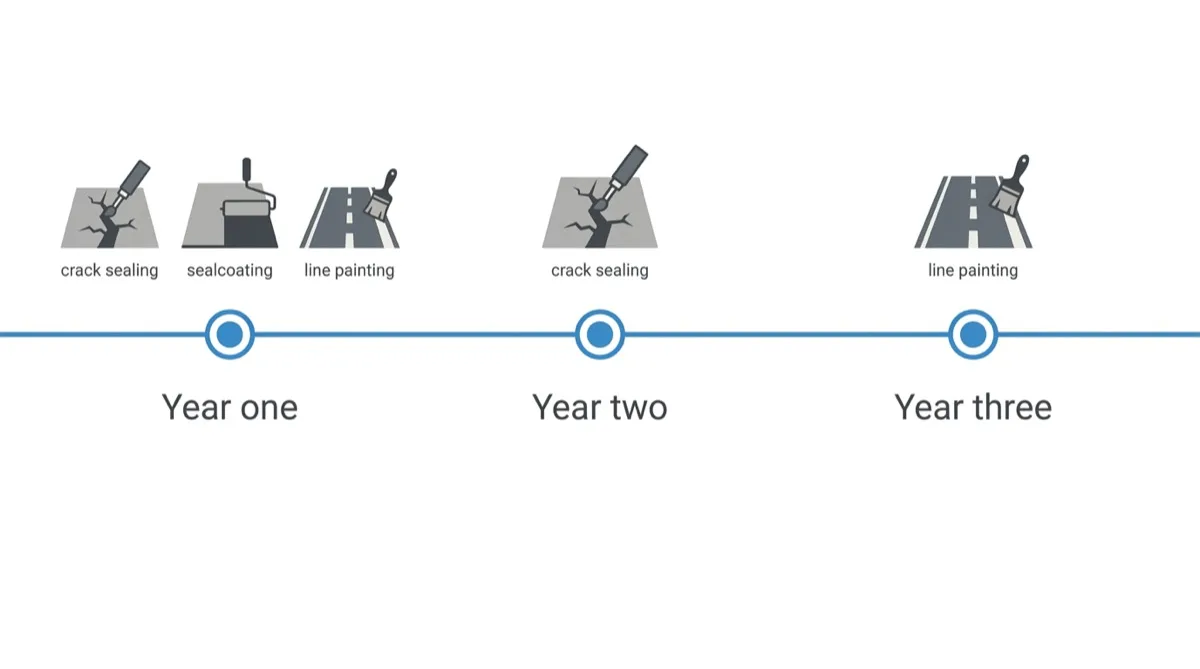
The order is set by the work itself. Crack sealing goes down ahead of the sealcoat, which is how Zusashi Maintenance describes its own hot rubberized crack fill at $1 to $3 per linear foot. The coating follows across the whole surface at Zusashi Maintenance's $0.20 to $0.40 per square foot. Striping goes on last, over the fresh coat, at Zusashi Maintenance's $4 to $9 per stall. Running those out of sequence means paying twice for at least one of them.
Year one is therefore the expensive year, and the size of it depends on how much crack footage the lot has accumulated. On a 10,000 square foot lot, the coating side sits at Zusashi Maintenance's $2,000 to $4,000 estimate. The crack-seal line scales independently, and a lot with heavy cracking can carry a materially larger figure on that line than a lot of identical area with light cracking. The striping line adds Zusashi Maintenance's $4 to $9 per stall and its $150 to $350 mobilization fee, unless that trip is shared with the sealing crew.
Ontario's HST rate is 13%, confirmed on the province's own HST page, and none of the published ranges above state whether they are quoted HST-included or HST-extra. Across a three-item scope, that convention is worth settling once at the start of the plan rather than argued over on each invoice.
Year two: the cheap year
Nothing in this site's price data supports resealing every year. The sealcoating guide records that commercial property managers commonly budget for sealcoating every two to three years rather than letting a lot degrade, and that is the only interval any source in the data offers. It is a budgeting convention rather than a measured coating life, and no source in the set publishes how long a two-coat application lasts on a specific lot under specific traffic.
That makes year two an inspection year with one line item on it. Cracks open over every Ontario winter, and crack sealing at Zusashi Maintenance's $1 to $3 per linear foot is the cheapest intervention available. The comparison the asphalt repair cost guide draws is direct: Zusashi Maintenance prices pothole repair at $100 to $500 per pothole depending on size and depth, so a crack sealed in year two is a pothole not paid for in year three. General commercial patching from Zusashi Maintenance runs $2 to $5 per square foot, which is the next step up once a crack has spread rather than widened.
Year two is also where the striping starts failing on a busy lot, which brings the paint choice made in year one into view.
Year three: restripe, and the overlay question
Zusashi Maintenance describes water-based paint as the standard option, lasting one to two years, and thermoplastic as a heat-applied alternative lasting roughly three to seven years at a higher upfront cost the page does not quantify. A lot striped in water-based paint in year one is due for a repaint by year three at the latest, and on a high-traffic drive lane it will be due sooner. That single fact is what gives a three-year plan its shape: the coating cycle and the paint cycle line up at the three-year mark, which is the natural point to put both crews on site at once.
Year three is also where the larger decision sits. The resurfacing cost guide carries The Paving Company's published $3 to $7 per square foot for an asphalt overlay on an existing surface, roughly ten to twenty times the $0.20 to $0.40 per square foot sealcoat range. Sure-Seal Pavement Maintenance prices cold milling at $0.75 to $1.25 per square foot on top of that, where the old surface has to be ground down first so the new layer sits flush with curbs and catch basins. The whole point of the three-year cycle is to push that number further out, and the point at which it stops working is when patching would cover a large share of the surface anyway.
Mobilization is the only saving the published figures demonstrate
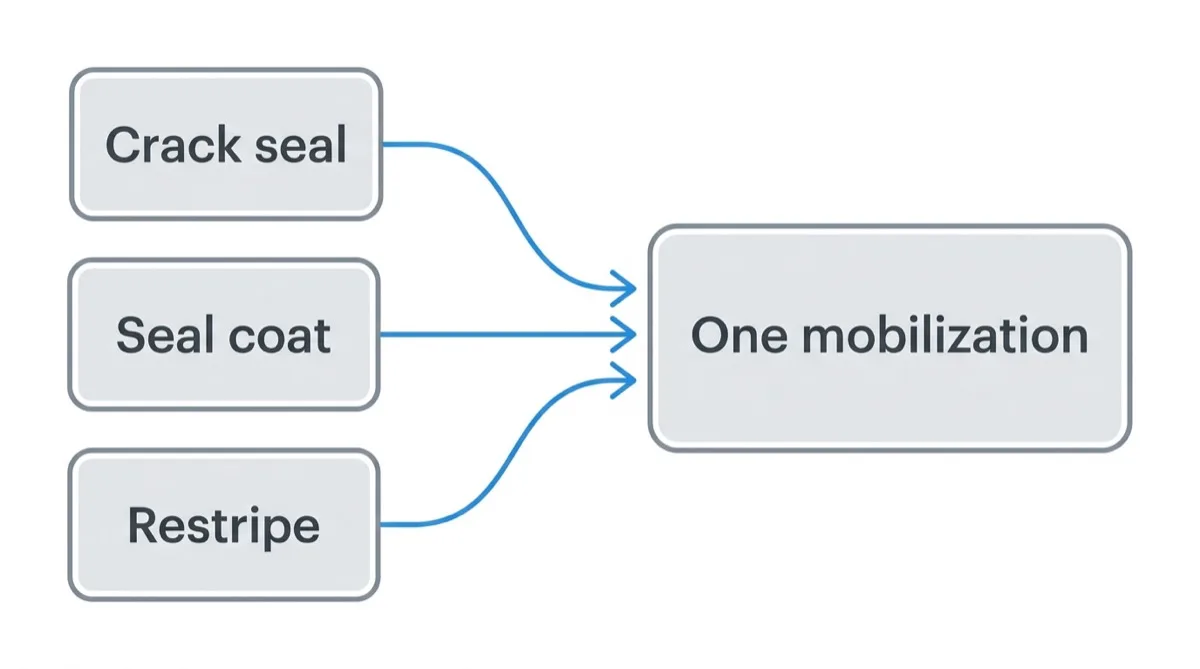
Bundling scopes is standard advice, and in this data it rests on one documented number. Zusashi Maintenance charges a $150 to $350 mobilization fee on top of per-stall striping pricing, and that fee is largely avoidable when the crew is already on site. Action Home Services publishes the same shape of cost on the sealing side, a minimum sealcoating project charge of $300 for a small commercial lot of roughly 750 square feet, which does not scale down for a smaller area.
No source in this site's price data publishes a discount for combining crack sealing, sealcoating and striping into one contract. The saving that can be evidenced is the trip, not the scope. That is a narrower claim than most bundling pitches make, and it is the one the published figures actually support.
The lines a three-item plan leaves out
Sealing, crack filling and striping cover the asphalt surface and nothing beneath or beside it. Drainage is the first omission. POM Plumbing, based in Etobicoke and serving the GTA, prices catch basin cleaning for commercial or industrial properties with multiple basins at $1,000 to $1,800 per service visit. The catch basin cost guide records that none of its sources publishes a separate dollar figure for structural repair as opposed to cleaning or full replacement, so a basin that needs more than clearing lands in a scope the data does not price.
Curbs are the second. Marcrete Contracting Ltd, serving Toronto and the GTA, prices minor concrete curb repair at $20 to $50 per linear foot, moderate repair at $50 to $100 per linear foot and full replacement or new installation at $100 to $250 or more per linear foot. It is the only Toronto-area source in this site's data publishing curb figures at all, which is worth knowing before a curb line on a bid is treated as a benchmark.
Neither of these belongs on a fixed three-year rotation the way the coating and the paint do, because neither has a published interval. They belong on the same site visit as the inspection that sets year two's crack footage, which is the cheapest moment to find out how many basins and how much curb are actually failing.
What the index shows about running the plan with one contractor
A shared mobilization needs a contractor listed for the work being shared. Of the 376 companies in the index, 96 are listed under sealcoating, 51 under line marking, 92 under parking lot paving and 87 under asphalt repair. Only 16 companies carry both sealcoating and line marking. Nine carry sealcoating, asphalt repair and line marking together, and five carry sealcoating, line marking and parking lot paving. Two hundred and three of the 376 are listed under exactly one category, and sixteen more carry none of the nine categories at all.
The distribution matters for the calendar more than for the price. A plan built around one crew doing all three items in year one and year three is drawing from a small part of the index, while a plan that accepts two contractors on separate visits draws from all of it and pays the mobilization fee twice. Line marking listings are also spread differently from the rest: Oshawa holds 6 of the 51, with 4 each in Whitby and Burlington, and 11 of the 51 carry no area on record. The category views are at sealcoating, line marking and parking lot paving, with area views including Oshawa and Mississauga.
The index records no warranty terms, no completion timelines and no years in business for any company, so nothing in a listing indicates whether a coat applied in year one will still be intact in year three. That is the part of the plan the data cannot fill in, and the written scope has to carry it instead: coat count, crack footage measured rather than estimated, stall count, paint type, and which of those the mobilization fee is attached to.
Frequently asked questions
What does a full maintenance pass cost on a 10,000 square foot lot?
- Zusashi Maintenance estimates $2,000 to $4,000 for the sealcoat alone on a 10,000 square foot commercial lot, on the two-coat application it describes. Crack sealing is separate at $1 to $3 per linear foot from the same source, and striping is separate again at $4 to $9 per stall plus a $150 to $350 mobilization fee. Area alone does not predict the last two lines.
Does every year need a sealcoat?
- Nothing in this site's price data supports an annual coat. The sealcoating guide records that commercial property managers commonly budget for sealcoating every two to three years rather than deferring maintenance until an overlay is needed. No source in the data measures how long a coat lasts on a specific lot, so the interval is a budgeting convention rather than a tested figure.
Which item drives the calendar?
- Paint life does. Zusashi Maintenance describes water-based paint as lasting one to two years and thermoplastic as lasting roughly three to seven years at a higher upfront cost the page does not put a number on. A lot striped in water-based paint in year one is due again by year three, which is what fixes the shape of a three-year plan.
What saving does the data actually demonstrate?
- One. Zusashi Maintenance charges a $150 to $350 mobilization fee on top of per-stall striping pricing, and that fee is avoidable when a crew is already on site for other work. No source in this site's price data publishes a discount for bundling scopes, so a shared trip is the only reduction the published figures support.
How many listed companies cover all three items?
- Few. Of the 376 companies in the index, 96 are listed under sealcoating and 51 under line marking, but only 16 carry both. Nine carry sealcoating, asphalt repair and line marking together, and five carry sealcoating, line marking and parking lot paving. Two hundred and three of the 376 are listed under exactly one category, and sixteen more carry none of the nine categories at all.