A spring walk of your lot after a GTA winter
Last updated: By The Pavement Desk
What winter does, and what this site can say about it
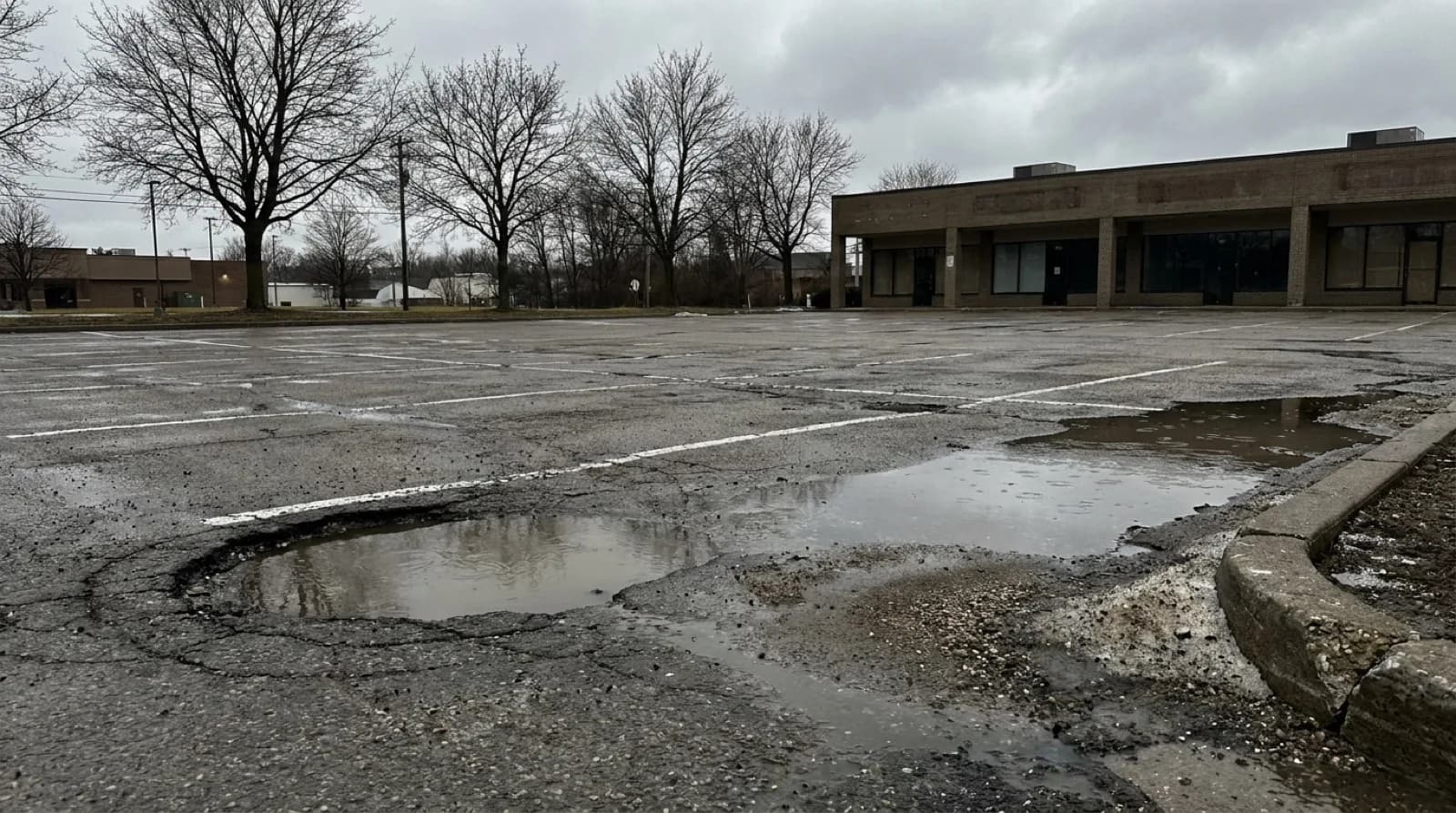
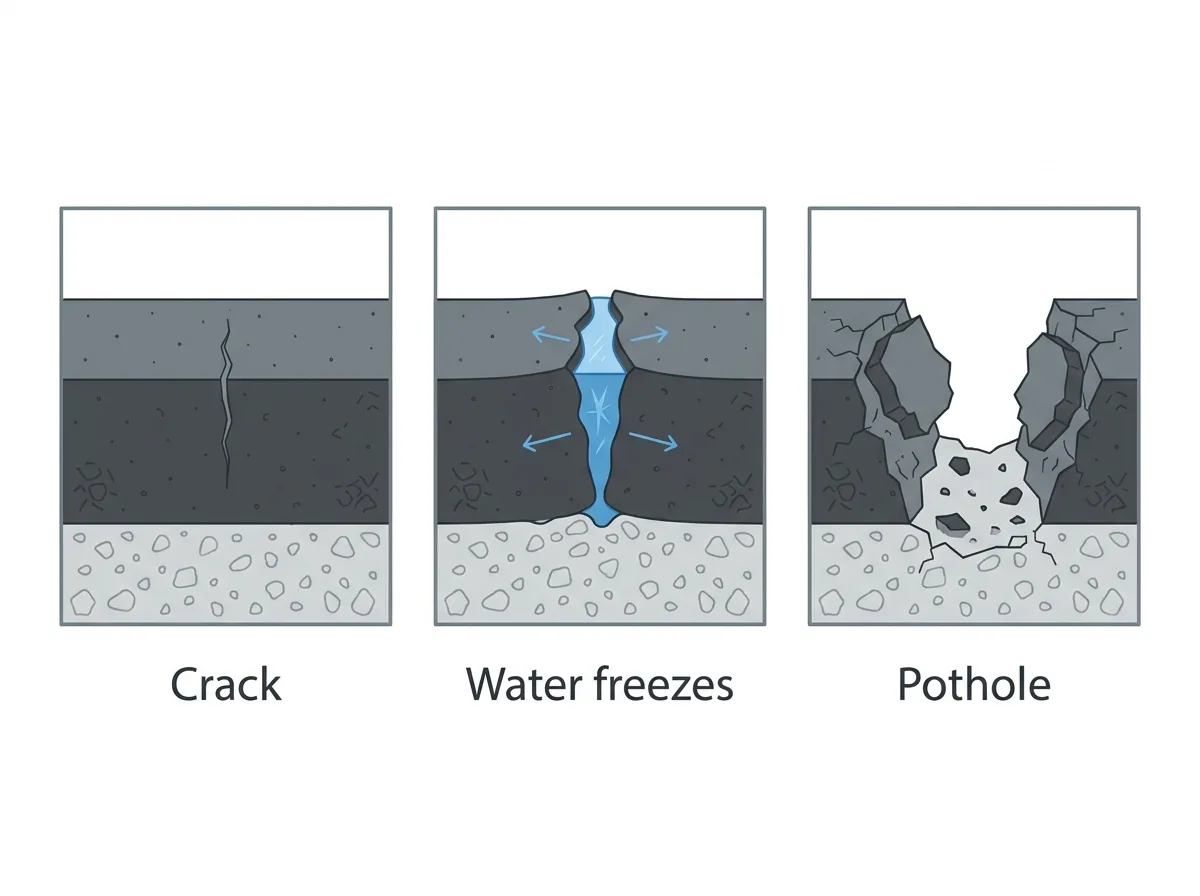
The mechanism is simple enough to describe. Water finds its way into a crack, freezes, expands, and widens the crack it is sitting in. Salt, plough blades and loaded vehicles all work on the same weakness. What this site has not measured is the rate: no page here says how many freeze and thaw cycles turn a given crack into a hole, because the index holds no job history, no condition surveys and no timelines for any property or company in it.
The cost side is documented. Zusashi Maintenance, serving Markham and the GTA since 2007, publishes hot-rubberized crack sealing at $1 to $3 per linear foot and pothole repair for commercial lots at $100 to $500 per pothole. The gap between those two published rates is what makes catching cracks early worth doing, since sealing a crack costs far less than fixing the pothole it becomes. Those two rows are the argument for walking the lot in spring rather than in the week the potholes get complained about.
The four quantities worth writing down
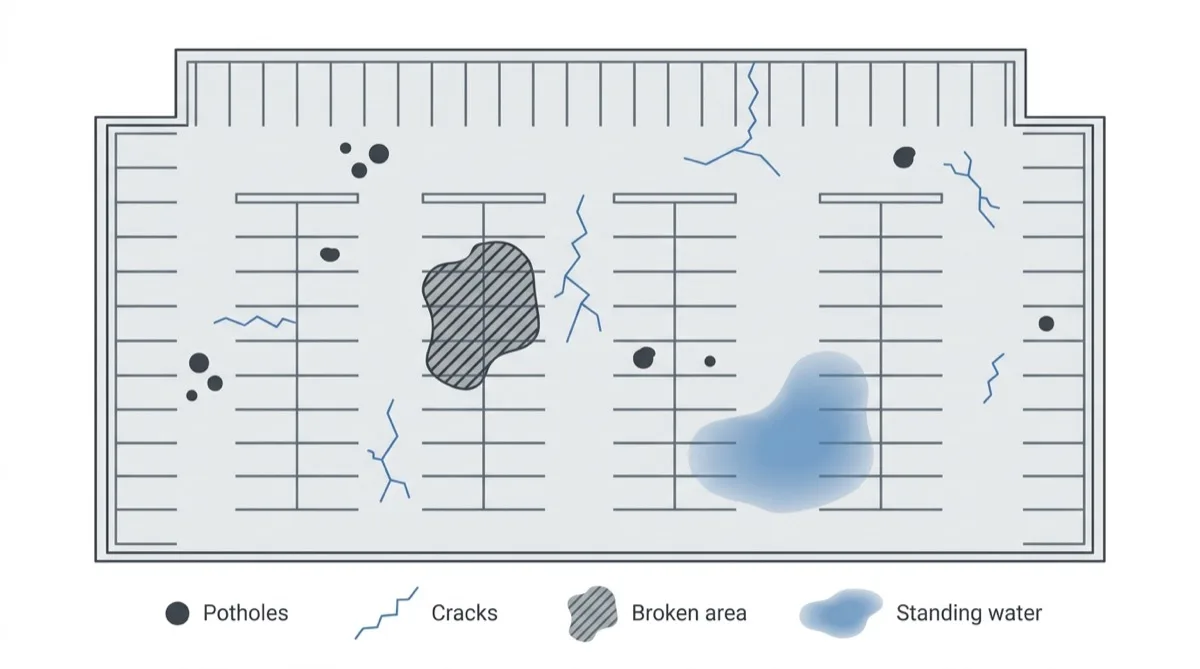
First, potholes, counted. Second, cracking, measured in linear feet, aisle by aisle. Third, any area where the surface has broken up as a continuous piece rather than as separate holes, measured in square feet, since general commercial patching is priced at $2 to $5 per square foot in Zusashi Maintenance's published range. Fourth, the low points that still hold water an hour after rain has stopped, marked on a sketch of the lot.
Those four quantities do more work than a description ever will. They let every bidder price the same lot, which is the only way three bids become comparable. They also let a rate be checked against a total: a length of cracking multiplied against a published per-linear-foot range gives a range to hold a quote up against, and a count of potholes does the same. Photographs help a contractor understand the lot. Numbers are what let you audit the bid that comes back. The asphalt repair cost guide holds every published rate the site carries for this work.
Standing water and the drains under it
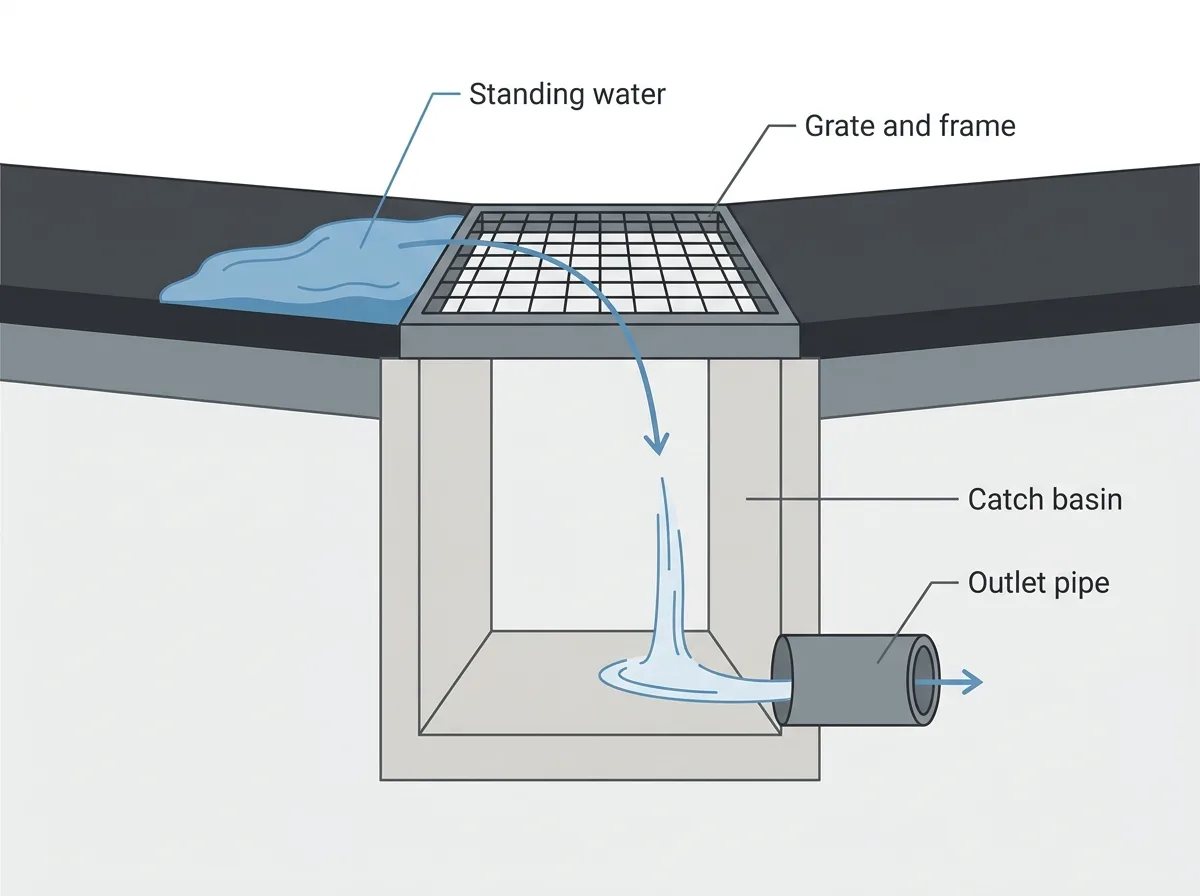
Water that sits after rain is a drainage symptom before it is a paving one, and it is worth chasing in that order. A blocked catch basin, a frame that has settled below grade, or a basin that was never quite at the low point will all show up as a puddle in exactly the place the asphalt then starts to fail. POM Plumbing, based in Etobicoke and serving the GTA, publishes commercial or industrial catch basin cleaning at $1,000 to $1,800 per service visit for properties with multiple basins. Ruling out a cleaning visit costs less than any structural work, so it belongs first in the sequence.
If the structure itself has failed, the itemization on the quote is what to read. The City of Toronto's own preliminary cost estimate for the Broadview Avenue Extension prices a fully installed catch basin, including excavation, bedding and connection, at $6,800 each. The Region of Peel's September 2022 functional cost estimate for an arterial road in Brampton prices only the precast 600x600 structure at $900, with frames and grates billed separately at $150 each and the connecting lead pipe at $60.00 to $75.00 per linear metre depending on diameter. A quote written against a full rebuild and one written against a frame and structure swap are different jobs at very different prices, and neither source itemizes the labour to break out and reset an old structure. Drainage is also the thinnest part of this index: 7 companies of the 376 carry the site drainage category, against 87 in asphalt repair. Both sit on the site drainage page and in the catch basin cost guide.
Curbs and edges take the same look
Curbs fail on the same freeze and thaw cycle as the surface, and they get inspected on the same walk because the damage tiers the same way. Marcrete Contracting Ltd, serving Toronto and the GTA, publishes minor concrete curb repair covering spalling, small cracks and chipped sections at $20 to $50 per linear foot, moderate repair covering larger cracks and sections needing a partial rebuild at $50 to $100 per linear foot, and full replacement or new installation at $100 to $250 or more per linear foot. It is the only Toronto-area source found publishing curb dollar figures, and it notes that labour in major urban markets such as Toronto and the GTA runs 10% to 25% higher than in smaller Ontario markets.
Curb work carries a permit question the asphalt usually does not. Where a repair touches City of Toronto property, meaning a boulevard, a sidewalk, or the curb cut connecting a lot to the street, it needs a street work permit from the City's District Right-of-Way Management office, and that permit is only issued to a driveway paving contractor licensed by the City. Requests for new driveway and walkway work must be submitted at least eight weeks before work starts, which is a lead time that will move a spring walk's findings into a summer schedule if it is discovered late. The index records 10 companies in the concrete curbs and sidewalks category, listed on the concrete curbs page, with rates in the curb cost guide.
Turning the list into as few visits as possible
The findings from one walk usually cross several trades, and the cheapest way to buy them is rarely one call at a time. Zusashi Maintenance's own guidance is that grouping several potholes into a single visit lowers the average per-pothole price against its $100 to $500 range, because a large share of that cost is getting the crew and truck onto the property at all. The same structure appears in striping, where Zusashi Maintenance publishes a $150 to $350 mobilization fee on top of $4 to $9 per stall, so faded lines noticed on the spring walk are cheapest to fix while another crew is already booked. Rates for that scope sit in the line marking cost guide.
What the index can tell you is which companies record more than one of these trades. Of the 376 companies listed, 87 carry asphalt repair, 96 sealcoating, 51 line marking, 92 parking lot paving, 10 concrete curbs and sidewalks and 7 site drainage. Those counts add to more than the index total because a company can sit in several categories at once, and the category list on a record is exactly what shows whether one call could cover two items from the walk. Recorded addresses cluster the same way: Vaughan holds 32 companies, Islington City Centre 27, Brampton 21 and Mississauga 20, so a shortlist drawn by area is easier to assemble in some parts of the market than others. The Brampton and Whitby pages show that split for their own areas.
What the walk does not settle
A walk produces quantities. It does not produce a verdict on whether the base under a failing area is sound, and that verdict is what decides whether the answer is patching at $2 to $5 per square foot in Zusashi Maintenance's range or something structural. It also does not produce a schedule, since the index holds no timelines or warranty terms for any company in it. And it does not produce a tax-inclusive budget: Ontario's HST rate is 13%, confirmed on the province's own HST page, so ask each bidder whether the quote is HST-included or HST-extra before setting two of them side by side.
Frequently asked questions
What is the spring walk actually looking for?
- Four quantities, written down. The number of potholes, the linear feet of cracking, the square feet of surface that has broken up as a continuous area, and the low points still holding water after rain. Those four map onto the three published GTA repair rates and onto the drainage work underneath, so a bid can be checked against them instead of accepted whole.
Why measure cracks in linear feet rather than counting them?
- Because that is the unit the work is sold in. Zusashi Maintenance prices hot-rubberized crack sealing at $1 to $3 per linear foot, so a measured length is what turns a rate into a number. A crack count says nothing about scope, since one crack running the length of a drive aisle and one hairline near a curb are the same count and very different jobs.
What does standing water on a lot point to?
- It points at drainage as well as surface. Water sitting after rain suggests a low point, a blocked basin or a frame sitting below grade. POM Plumbing, based in Etobicoke and serving the GTA, prices commercial or industrial catch basin cleaning with multiple basins at $1,000 to $1,800 per service visit, which is worth ruling out before anyone quotes structural work on the basin itself.
Does catching a crack early actually save money?
- The published rates put a large gap on either side of that decision. Zusashi Maintenance quotes $1 to $3 per linear foot for hot-rubberized crack sealing and $100 to $500 per pothole, and the gap between those two published rates is the argument for catching cracks early. How fast a specific crack turns into a pothole is not something this index has measured on any lot.
Is a spring walk enough to price the work?
- It is enough to write a scope that every bidder prices identically, which is the point. It stops short of a structural assessment. Whether an area needs patching at $2 to $5 per square foot in Zusashi Maintenance's range or the base underneath has failed is a judgement made on site, and the answer changes which guide the numbers come from.