Paving and striping in the right order
Last updated: By The Pavement Desk
The order the work has to run in
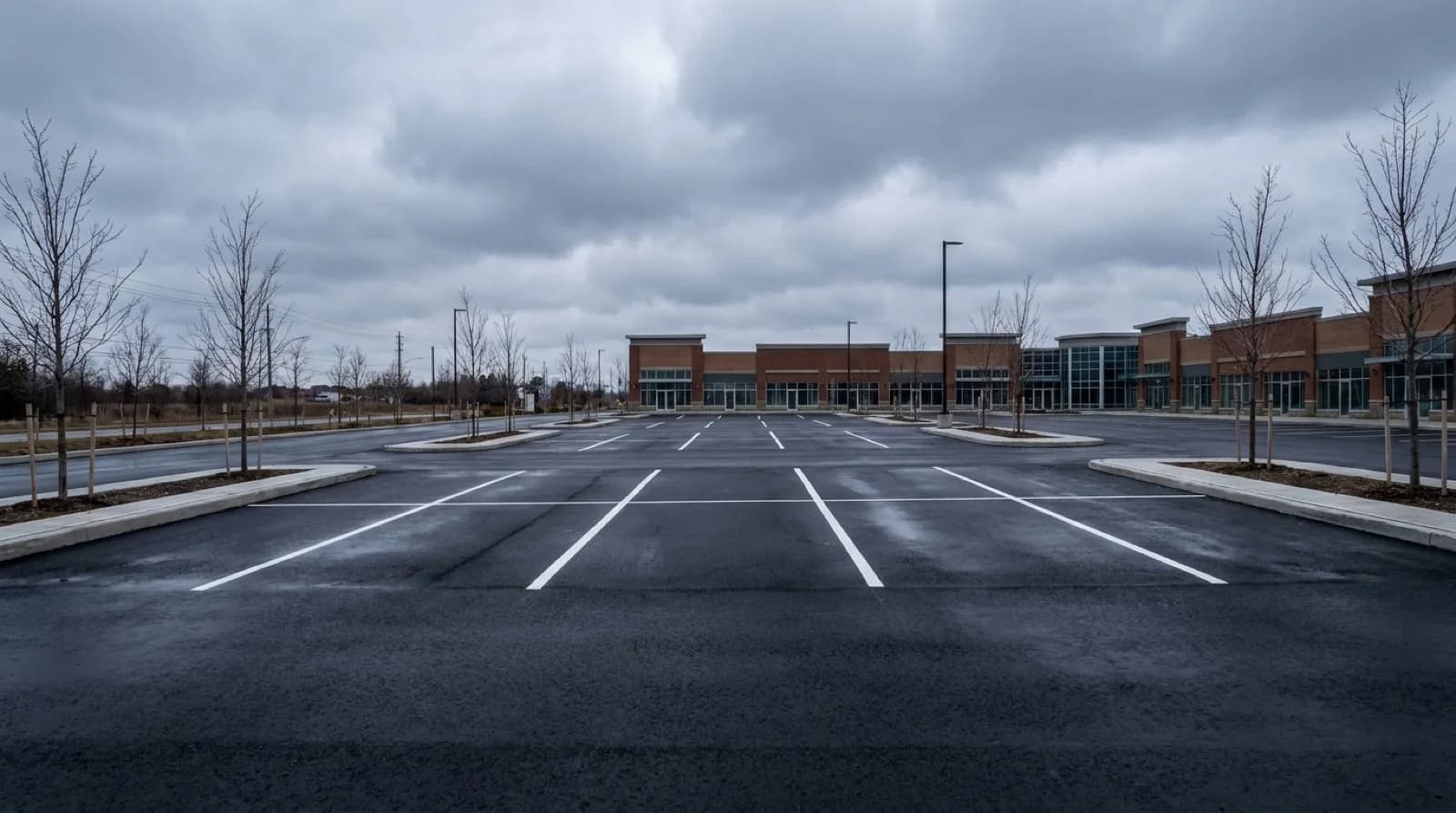
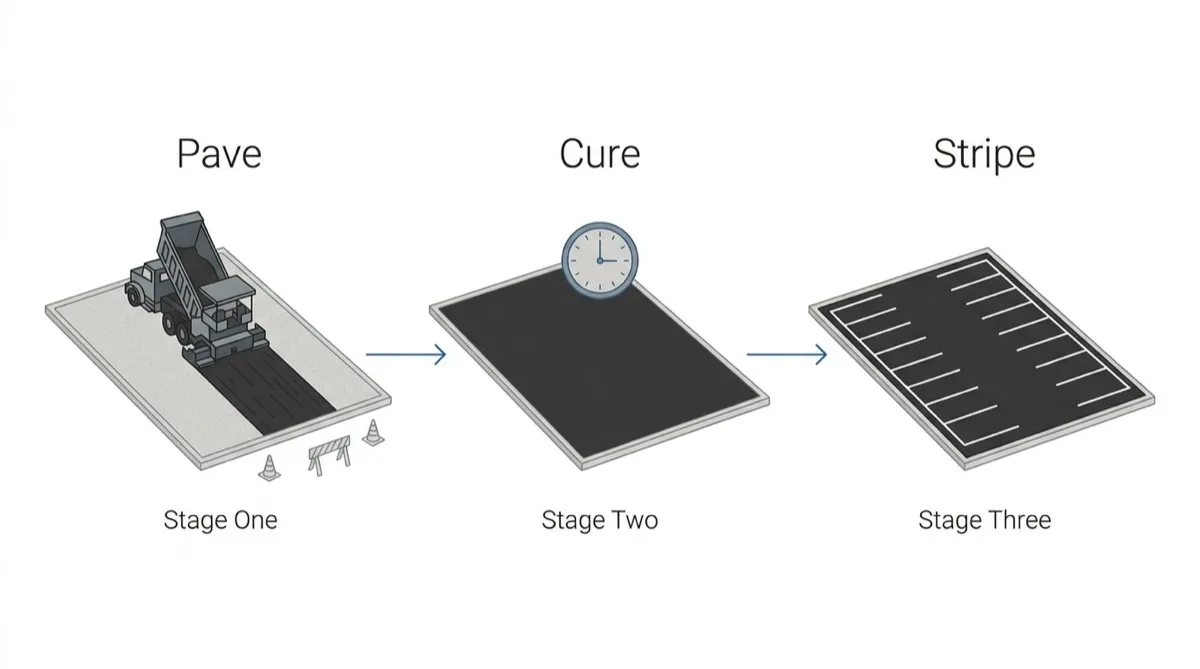
Paint goes on last. A repave, an overlay or a sealcoat all put a new surface over the old one, and every stall line, arrow, fire route and accessible symbol on that old surface disappears underneath it. Zusashi Maintenance prices commercial sealcoating at $0.20 to $0.40 per square foot for the two-coat application it describes, and that coating covers markings the way the asphalt itself does. Any striping paid for shortly before one of those surface treatments has been bought twice.
The sequence gets complicated on a phased job, where one section of a lot is repaved while the rest stays open. Tenants still need to park, delivery vehicles still need a route, and the fire route still needs to be identifiable. That pushes property managers toward temporary marks on the finished section, then a full layout when the last section is done. This site holds no cure time, set time or completion data for any company in it, so how long a section sits between the paving crew leaving and the striping crew arriving is a term to settle with the contractor in writing rather than a number this page can supply.
The mobilization fee is the line item that doubles
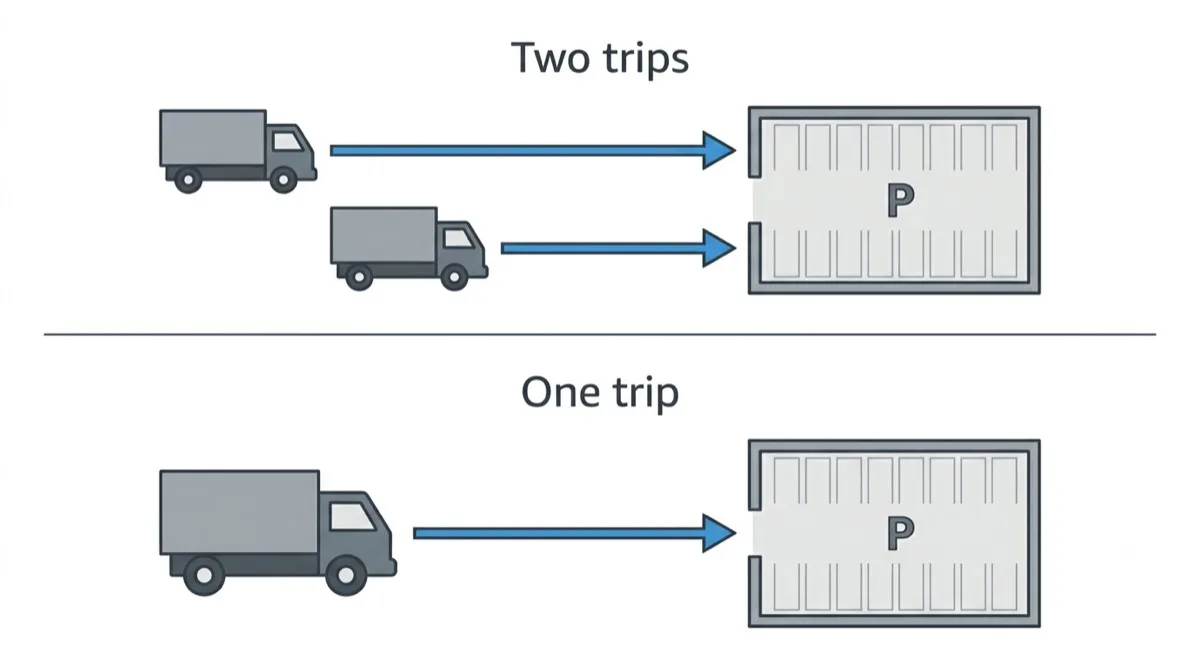
Mobilization is what a contractor charges to get a crew, a truck and equipment onto your property at all. Zusashi Maintenance, serving Markham and the GTA since 2007, publishes a $150 to $350 mobilization fee on top of its per-stall pricing, applied regardless of how many stalls get painted. That structure is the whole argument for sequencing. Two striping trips means two mobilization fees on a lot where the paint itself may not have changed much.
The fee is large relative to the work on a small lot. Toronto Line Painting's $3 to $5 per stall for a 20 to 30 stall plaza sets the low end of the per-stall rate and Zusashi Maintenance's $4 to $9 per stall restripe rate the high end, and adding Zusashi Maintenance's $150 to $350 mobilization fee to either puts a 30-stall lot at roughly $240 to $620 for striping alone, mobilization included. On a lot that size the flat fee is a serious share of the invoice. The same source's own advice is to combine striping with another maintenance visit already booked on site, which is the practical version of the same arithmetic: if a crew is coming anyway, the trip charge stops being a separate cost.
Restripe or new layout: which price the second visit carries
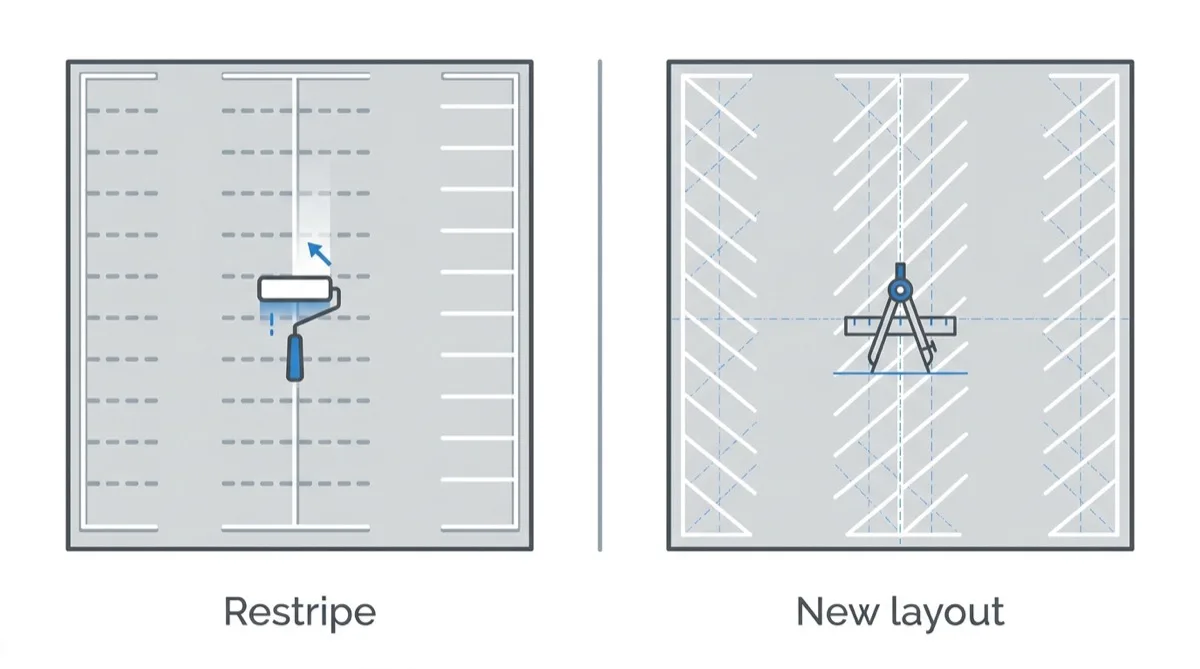
There are two different jobs hiding behind the word striping, and they are priced on different bases. Repainting lines that are still visible is a restripe, quoted per stall: $4 to $9 per stall from Zusashi Maintenance, with Toronto Line Painting independently quoting small plaza restripes of 20 to 30 stalls around $3 to $5 per stall. Laying out a plan on a surface with no markings is a new layout, and VIP Paving prices a new line layout on a 10,000 square foot commercial lot at $450 to $1,200 as a project total. VIP Paving also prices line painting by footage on large open lots with long straight runs, at $0.15 to $0.40 per linear foot.
A freshly paved surface has no old lines by definition, so the striping visit that follows paving is a new layout, priced as a project rather than as a per-stall repaint. VIP Paving's reason for the difference is that crews laying out a fresh plan cannot follow existing markings and have to set the plan out from scratch. Confirm in writing which of those two scopes a bid covers, because a per-stall restripe number quoted for a lot that will be repaved first is describing a job that will not exist by the time the crew arrives.
The accessible stall count gets decided before the paint arrives
Accessible stalls cost more than standard ones. VIP Paving prices the wheelchair symbol marking itself at $15 to $30 per stall on top of the regular stall paint, and Zusashi Maintenance separately notes that each accessible stall costs more than a standard one because of the symbol and layout, without publishing its own figure. The count, though, is set by regulation rather than by the striping contractor, and two instruments answer it with different numbers.
Provincially, Ontario Regulation 191/11, section 80.36 (1), requires one space meeting the Type A requirements where a lot has 12 spaces or fewer and four per cent of the total where there are 13 to 100. Section 80.34 sets a minimum width of 3,400 mm for a Type A space and 2,400 mm for a Type B, with section 80.35 (2) requiring a shared access aisle of at least 1,500 mm running the full length of the space, marked with high tonal contrast diagonal lines. Section 80.32 applies those requirements only where an obligated organization constructs a new off-street parking facility or redevelops one, and section 80.1 defines redeveloped as planned significant alterations while expressly excluding maintenance, whose own definition gives painting and minor repairs as examples.
Inside Toronto the city sets a different rate. Zoning By-law 569-2013, regulation 200.15.10.10 (1), requires one accessible space where there are fewer than 13 effective parking spaces, one for every 25 effective spaces or part thereof from 13 to 100, and five spaces plus one for every 50 effective spaces or part thereof above 100, attached to a building being erected or enlarged. Medical offices and clinics are rated separately at 10 per cent, rounded up, under regulation 200.15.10.10 (2). The city's July 31, 2024 office consolidation prints two versions of the minimum stall width, 3.9 metres and a 3.4 metre version marked as under appeal, so confirm the operative figure with City Planning before a layout is set out. A project can be caught by one instrument, both, or neither. Where both apply, meet the higher count. All of that is settled on paper before a striping crew books a date, and the site's line marking cost guide carries the full rule in one place.
One contractor or two
The index records these as separate trades. Of the 376 companies listed, 92 carry the parking lot paving category and 51 carry line marking. A company can sit in more than one category, so those counts overlap rather than divide the index. The labels Google Maps applies to the same records point the same way: 145 are labelled paving contractor and 29 are labelled line marking service. Whether a single company can cover both parts of the sequence is a question the record answers company by company, and the parking lot paving and line marking category pages are where those records sit side by side.
Coordinating two contractors around one mobilization means somebody has to make the calls, and the index is thin on the channels for it. Phone numbers appear on 358 of the 376 records and websites on 299, but email addresses appear on none of them. The practical consequence is that scheduling the striping visit against the paving visit happens by phone, and the record of what was agreed exists only in whatever the contractors put in writing afterwards.
What to settle in writing before the paving crew books
Four things determine whether the sequence saves money or costs it. First, the striping scope: restripe at $4 to $9 per stall or a new layout at $450 to $1,200 on a 10,000 square foot lot, using Zusashi Maintenance's and VIP Paving's published figures as the check on which one a bid describes. Second, who wears the mobilization fee if a second striping trip becomes necessary, given Zusashi Maintenance's $150 to $350 range for it. Third, the accessible stall count and which rule the project falls under, since a reconfiguration and a like-for-like repaint sit on opposite sides of that line.
The fourth is the paperwork around both trades. Ontario's HST rate is 13%, confirmed on the province's own HST page, so ask each contractor whether a quote is HST-included or HST-extra before setting two bids next to each other. The City of Toronto requires any business that repaves or repairs driveways and lots to hold a Driveway Paving Contractor licence, which costs $495.12 to apply for and $293.14 a year to renew, and requires $2,000,000 in commercial general liability insurance plus a criminal record and judicial matters check. Ask to see the licence before signing. Costs on the paving side of the same project sit in the parking lot paving cost guide.
Frequently asked questions
Does the striping crew need a separate visit from the paving crew?
- Usually yes, since striping and paving are quoted as separate scopes. Zusashi Maintenance prices a water-based restripe at $4 to $9 per stall plus a $150 to $350 mobilization fee, and that fee attaches to the striping trip rather than the paving one. The index records 92 companies in parking lot paving and 51 in line marking, and a company can carry both categories.
When is the mobilization fee charged?
- Zusashi Maintenance charges a $150 to $350 mobilization fee on top of per-stall pricing, so it applies once per striping trip regardless of stall count. A lot that gets temporary marks and then a final layout has paid for two trips. The same source lists combining striping with a maintenance visit already booked on site as a way to avoid the separate fee.
Is a restripe priced the same as a new layout after repaving?
- No. Zusashi Maintenance prices a restripe of existing, visible lines at $4 to $9 per stall, and Toronto Line Painting quotes small plaza restripes of 20 to 30 stalls around $3 to $5 per stall. VIP Paving prices a new layout on a 10,000 square foot lot at $450 to $1,200 as a project total, because a crew laying out a fresh plan cannot follow old markings.
Does repaving change how many accessible stalls a lot needs?
- It can. O. Reg. 191/11 section 80.36 (1) sets the provincial minimum, but section 80.32 applies it only where an obligated organization constructs or redevelops a parking facility, and section 80.1 excludes maintenance such as repainting. Inside Toronto, Zoning By-law 569-2013 regulation 200.15.10.10 sets its own rate tied to a building being erected or enlarged. Where both apply, meet the higher count.